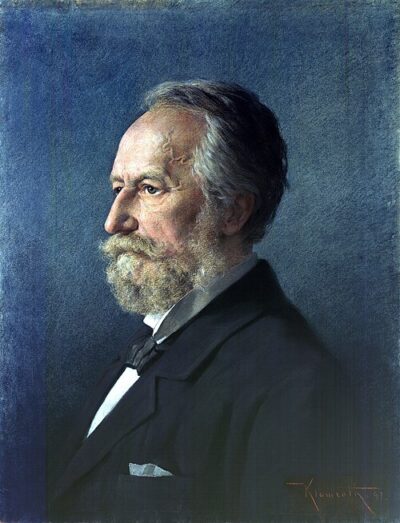
Fick's laws of diffusion
Fick's laws of diffusion is a mathematical descriptions of molecular diffusion.
All 2 facts, and where they come from
Facts
2 facts · 0 confirmed by two sources · 0 cited · 2 from one source
Where this comes from
Papalocal keeps its own record. It started from these sources; what each one said is kept here as it was copied, so a change on their side never changes this page by itself. Tap one to read its version.
What Wikidata says · copied November 17, 2026 · revision 2567950818
- Described as
- mathematical descriptions of molecular diffusion
- What it is
- physical law
- Named after
- Adolf Fick
- Wikipedias with a page
- 32
Wikidata item Q856634 (wikidata.org/wiki/Q856634), public domain (CC0). Copied 2026-11-17.
What Wikipedia says · copied November 17, 2026 · revision 1376065888
Fick's laws of diffusion describe diffusion and were first posited by Adolf Fick in 1855 on the basis of largely experimental results. They can be used to solve for the diffusion coefficient, D. Fick's first law can be used to derive his second law, which in turn is identical to the diffusion equation.
Fick's first law: Movement of particles from high to low concentration (diffusive flux) is directly proportional to the particle's concentration gradient.
Fick's second law: Prediction of change in concentration gradient with time due to diffusion.
A diffusion process that obeys Fick's laws is called normal or Fickian diffusion; otherwise, it is called anomalous diffusion or non-Fickian diffusion.
From the Wikipedia article “Fick's laws of diffusion” (en.wikipedia.org/wiki/Fick's_laws_of_diffusion), by its contributors, under CC BY-SA 4.0 (creativecommons.org/licenses/by-sa/4.0/). Copied 2026-11-17; not changed.
Confirmed Two sources agree. Cited One source, and it names where it got it. One source One source, without a reference of its own. Sources disagree The sources disagree. We show the best-supported value and keep theirs below.