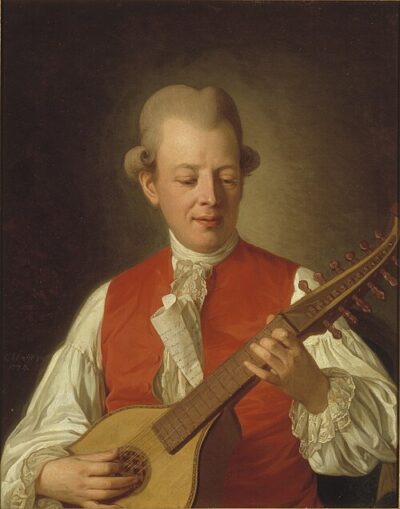
Fredman's Epistles
Fredman's Epistles is a book by Carl Michael Bellman. It came out in 1790.
- Released
- 1790
- Written by
- Carl Michael Bellman
- Genre
- Rococo
- Country of origin
- Sweden
All 9 facts, and where they come from
Facts
9 facts · 0 confirmed by two sources · 2 cited · 7 from one source
Where this comes from
Papalocal keeps its own record. It started from these sources; what each one said is kept here as it was copied, so a change on their side never changes this page by itself. Tap one to read its version.
What Wikidata says · copied November 17, 2026 · revision 2447755025
- Described as
- book by Carl Michael Bellman
- Other names
- Epistles of Fredman, Fredmans epistlar
- What it is
- song book; literary cycle
- Written by
- Carl Michael Bellman
- Publisher
- Olof Åhlström
- Genre
- Rococo · 1 reference
- Released
- 1790 · 1 reference
- Language
- Swedish · 1 reference
- Country of origin
- Sweden · 1 reference
- Named after
- Jean Fredman
- Wikipedias with a page
- 4
Wikidata item Q5383621 (wikidata.org/wiki/Q5383621), public domain (CC0). Copied 2026-11-17.
What Wikipedia says · copied November 17, 2026 · revision 1384302203
Fredmans epistlar (English: Fredman's Epistles) is a collection of 82 poems set to music by Carl Michael Bellman, a major figure in Swedish 18th century song. Though first published in 1790, it was created over a period of twenty years from 1768 onwards. A companion volume, Fredmans sånger (Fredman's Songs) was published the following year.
The Epistles vary widely in style and effect, from Rococo-themed pastorale with a cast of gods and demigods from classical antiquity to laments for the effects of Brännvin-drinking, tavern-scenes, and apparent improvisations. The lyrics, based on the lives of Bellman's contemporaries in Gustavian-age Sweden, describe a gallery of fictional and semi-fictional characters and events in Stockholm. Jean Fredman, an alcoholic former watchmaker, is the central character and fictional narrator. The "soliloquy" of Epistle 23, a description of Fredman lying drunk in the gutter and then recovering in the Crawl-In Tavern, was described by Oscar Levertin as "the to-be-or-not-to-be of Swedish literature". Ulla Winblad, based on one of Bellman's friends, is the chief of the fictional "nymphs". She is half goddess, half prostitute, a key figure among the demimonde characters of Fredman's Epistles.
The Epistles are admired for the way that their poetry and music fit so well together. Bellman chose not to compose the tunes, instead borrowing and adapting existing melodies, most likely to exploit the humour of contrasting the associations of well-known tunes with the meanings he gave them. This may also have been intended to provide historical depth to his work; he sometimes devoted considerable energy to adapting melodies to fit an Epistle's needs.
Many of the Epistles have remained culturally significant in Scandinavia, especially in Sweden. They are widely sung and recorded: by choirs such as the Orphei Drängar, by professional solo singers such as Fred Åkerström and Cornelis Vreeswijk, and by ensemble singers such as Sven-Bertil Taube and William Clauson. The Epistles have been translated into German, French, English, Russian, Polish, Finnish, Italian and Dutch.
From the Wikipedia article “Fredmans epistlar” (en.wikipedia.org/wiki/Fredmans_epistlar), by its contributors, under CC BY-SA 4.0 (creativecommons.org/licenses/by-sa/4.0/). Copied 2026-11-17; not changed.
Confirmed Two sources agree. Cited One source, and it names where it got it. One source One source, without a reference of its own. Sources disagree The sources disagree. We show the best-supported value and keep theirs below.
Picture: Wikimedia Commons: Fredmans Epistlar frontispiece.jpg · See Commons file page