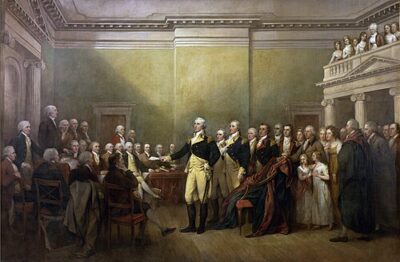
General George Washington Resigning His Commission
General George Washington Resigning His Commission is a painting by John Trumbull. It came out in 1824.
- Came out
- 1824
- Created by
- John Trumbull
- Genre
- history painting
- Country of origin
- United States
All 5 facts, and where they come from
Facts
5 facts · 0 confirmed by two sources · 1 cited · 4 from one source
Where this comes from
Papalocal keeps its own record. It started from these sources; what each one said is kept here as it was copied, so a change on their side never changes this page by itself. Tap one to read its version.
What Wikidata says · copied November 17, 2026 · revision 2369827629
- Described as
- painting by John Trumbull
- What it is
- painting
- Created by
- John Trumbull · 1 reference
- Genre
- history painting
- Country of origin
- United States
- Came out
- 1824
- Wikipedias with a page
- 3
Wikidata item Q43753419 (wikidata.org/wiki/Q43753419), public domain (CC0). Copied 2026-11-17.
What Wikipedia says · copied November 17, 2026 · revision 1385903850
General George Washington Resigning His Commission is a large-scale oil painting by American artist John Trumbull of General George Washington resigning his commission as commander-in-chief of the Continental Army on December 23, 1783 to the Congress of the Confederation, then meeting in the Maryland State House at Annapolis, Maryland. The painting was commissioned in 1817, started in 1822, finished in 1824, and is now on view in the United States Capitol rotunda in Washington, D.C., along with three other large-scale paintings by Trumbull about the American Revolutionary War.
Trumbull considered George Washington's resignation as commander-in-chief to be "one of the highest moral lessons ever given to the world".
From the Wikipedia article “General George Washington Resigning His Commission” (en.wikipedia.org/wiki/General_George_Washington_Resigning_His_Commission), by its contributors, under CC BY-SA 4.0 (creativecommons.org/licenses/by-sa/4.0/). Copied 2026-11-17; not changed.
Confirmed Two sources agree. Cited One source, and it names where it got it. One source One source, without a reference of its own. Sources disagree The sources disagree. We show the best-supported value and keep theirs below.
Picture: John Trumbull, via Wikimedia Commons · Public domain