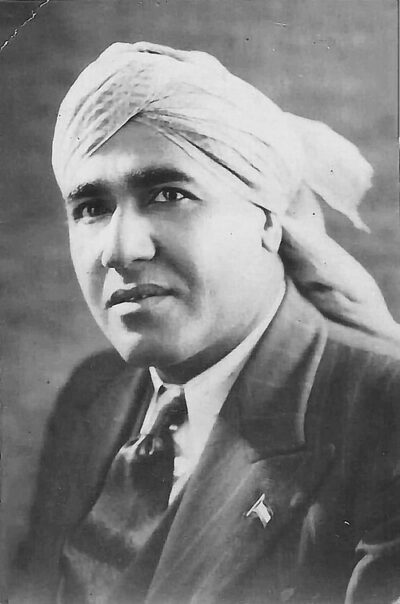
Ghadar Movement
The Ghadar Movement is an Indian revolutionary movement. It was founded in 1913 by Sohan Singh Bhakna and Bhai Bhagwan Singh. It stands for revolutionary socialism.
- Country
- United States
- Founded
- 1913
- Ideology
- revolutionary socialism
All 7 facts, and where they come from
Facts
7 facts · 0 confirmed by two sources · 1 cited · 6 from one source
Where this comes from
Papalocal keeps its own record. It started from these sources; what each one said is kept here as it was copied, so a change on their side never changes this page by itself. Tap one to read its version.
What Wikidata says · copied November 18, 2026 · revision 2489611535
- Described as
- Indian revolutionary movement
- Other names
- Ghadar Party
- What it is
- political party
- Founded
- 1913
- Ended
- 1919
- Founded by
- Sohan Singh Bhakna · 1 reference; Bhai Bhagwan Singh · 1 reference
- Country
- United States
- Ideology
- revolutionary socialism
- Wikipedias with a page
- 19
Wikidata item Q2655840 (wikidata.org/wiki/Q2655840), public domain (CC0). Copied 2026-11-18.
What Wikipedia says · copied November 18, 2026 · revision 1385373478
The Ghadar movement or Ghadar Party was an early 20th-century international political movement founded by expatriate Indians with the aim of overthrowing British rule in India. Many of the Ghadar Party founders and leaders, including Sohan Singh Bhakna, went on and join the Babbar Akali Movement and helped it in logistics as a party and publishing its own newspaper in the post-World War I era. The early movement was created by the revolutionaries who lived and worked on the West Coast of the United States and Canada, and the movement later spread to India and Indian diasporic communities around the world. The official founding has been dated to a meeting on 15 July 1913 in Astoria, Oregon, and the group splintered into two factions the first time in 1914, with the Sikh-majority faction known as the “Azad Punjab Ghadar” and the Hindu-majority faction known as the “Hindustan Ghadar.” The Azad Punjab Ghadar Party's headquarters and anti-colonial newspaper publications headquarters remained in the Stockton Gurdwara in Stockton, California, and the Hindustan Ghadar Party's headquarters and Hindustan Ghadar newspaper relocated to nearby Oakland, California.
During World War I in 1914, the Ghadar Movement, a group of Indian revolutionaries, allied with Germany, finding common ground in their opposition to British imperial rule in India. Germany strategically considered these revolutionaries vital allies against the British Empire. Their collaborative goal was to destabilize British control through a multifaceted strategy, encompassing a synchronized effort to invade British India via Afghanistan, provide resources to bolster the Indian independence movement, and disseminate propaganda to incite mutiny within the British Indian Army. Consequently, some Ghadar party members returned to Punjab to instigate an armed revolution for Indian Independence. The Ghadar Mutiny, as this uprising became known, involved Ghadarites smuggling arms into India and encouraging Indian troops to revolt against the British. This attempt was ultimately unsuccessful, leading to the execution of 42 mutineers after the Lahore Conspiracy Case trial. Undeterred, Ghadarites continued underground anti-colonial actions from 1914 to 1917 with support from Germany and Ottoman Turkey, a period known as the Hindu–German Conspiracy, which culminated in a sensational trial in San Francisco in 1917.
Following the war's conclusion, the party in the United States fractured into a communist and an anti-communist faction. The party was formally dissolved in 1948. Key participants in the Ghadar Movement included K. B. Menon, Sohan Singh Bhakna, Mewa Singh Lopoke, Bhai Parmanand, Vishnu Ganesh Pingle, Bhagwan Singh Gyanee, Har Dayal, Tarak Nath Das, Bhagat Singh Thind, Kartar Singh Sarabha, Udham Singh, Abdul Hafiz Mohamed Barakatullah, Rashbehari Bose, Ishar Singh Gill and Gulab Kaur. The insurrectionary ideals of the Ghadar Party influenced the members of the Indian Independence Movement opposed to Gandhian nonviolence. To carry out other revolutionary activities, "Swadesh Sevak Home" at Vancouver and United India House at Seattle was set up.
In 1918, the party split into the Kirti Kisan Sabha, which had communist and socialist leanings and later aligned itself with the Indian National Congress, and the Babbar Akali faction, which was Sikh-centric.
From the Wikipedia article “Ghadar movement” (en.wikipedia.org/wiki/Ghadar_movement), by its contributors, under CC BY-SA 4.0 (creativecommons.org/licenses/by-sa/4.0/). Copied 2026-11-18; not changed.
Confirmed Two sources agree. Cited One source, and it names where it got it. One source One source, without a reference of its own. Sources disagree The sources disagree. We show the best-supported value and keep theirs below.