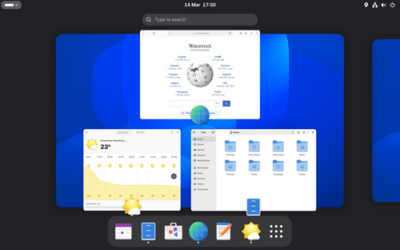
GNOME
GNOME is a desktop environment and graphical user interface. It came out in 1999. It was made by the GNOME Foundation, The GNOME Project and GNU Project.
- Released
- March 3, 1999
- Came out
- August 15, 1997
- Made by
- GNOME Foundation
All 9 facts, and where they come from
Facts
9 facts · 0 confirmed by two sources · 3 cited · 6 from one source
Where this comes from
Papalocal keeps its own record. It started from these sources; what each one said is kept here as it was copied, so a change on their side never changes this page by itself. Tap one to read its version.
What Wikidata says · copied November 17, 2026 · revision 2561794223
- Described as
- desktop environment and graphical user interface
- Other names
- GNU Network Object Model Environment
- What it is
- desktop environment; GNU package · 1 reference; computing platform
- Made by
- GNOME Foundation; The GNOME Project; GNU Project (–2009)
- Released
- March 3, 1999 · 1 reference
- Came out
- August 15, 1997 · 1 reference
- Official website
- https://www.gnome.org/
- Wikipedias with a page
- 83
Wikidata item Q44316 (wikidata.org/wiki/Q44316), public domain (CC0). Copied 2026-11-17.
What Wikipedia says · copied November 17, 2026 · revision 1386174038
GNOME () is a desktop environment and suite of software for Linux and BSD developed by the GNOME Project and released as free and open source software. The primary components of GNOME are the GNOME Shell, which provides features such as virtual desktops and window management; and the GNOME Core Applications, which distribute a suite of software that integrates with the shell and provides basic system features such as a file manager and a computer configuration application.
The GNOME Project is composed of both volunteers and paid contributors, the largest contributor being Red Hat. In 2023 and 2024, GNOME received €1,000,000 from Germany's Sovereign Tech Fund.
From the Wikipedia article “GNOME” (en.wikipedia.org/wiki/GNOME), by its contributors, under CC BY-SA 4.0 (creativecommons.org/licenses/by-sa/4.0/). Copied 2026-11-17; not changed.
Confirmed Two sources agree. Cited One source, and it names where it got it. One source One source, without a reference of its own. Sources disagree The sources disagree. We show the best-supported value and keep theirs below.
Picture: Guilieb (formerly Filorinwiki), via Wikimedia Commons · CC BY-SA 4.0