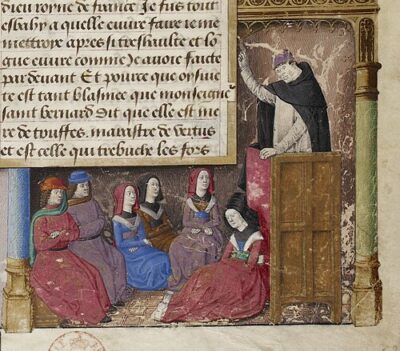
Golden Legend
Golden Legend is a collection of hagiographies compiled by Jacobus de Voragine c.1264. It came out in 1298.
- Published
- 1298
- Written by
- Jacobus de Voragine
- Genre
- hagiography
All 5 facts, and where they come from
Facts
5 facts · 0 confirmed by two sources · 0 cited · 5 from one source
Where this comes from
Papalocal keeps its own record. It started from these sources; what each one said is kept here as it was copied, so a change on their side never changes this page by itself. Tap one to read its version.
What Wikidata says · copied November 17, 2026 · revision 2570804556
- Described as
- collection of hagiographies compiled by Jacobus de Voragine c.1264
- What it is
- literary work
- Written by
- Jacobus de Voragine
- Genre
- hagiography
- Published
- 1298
- Language
- medieval Latin
- Wikipedias with a page
- 44
Wikidata item Q129493 (wikidata.org/wiki/Q129493), public domain (CC0). Copied 2026-11-17.
What Wikipedia says · copied November 17, 2026 · revision 1384744490
The Golden Legend (Latin: Legenda aurea or Legenda sanctorum) is a collection of 153 hagiographies by Jacobus de Voragine that was widely read in Europe during the Late Middle Ages. More than a thousand manuscripts of the text have survived. It was probably compiled around 1259 to 1266, although the text was added to over the centuries.
Initially entitled Legenda sanctorum (Readings of the Saints), it gained its popularity under the title by which it is best known. It overtook and eclipsed earlier compilations of abridged legendaria, the Abbreviatio in gestis et miraculis sanctorum attributed to the Dominican chronicler Jean de Mailly and the Epilogus in gestis sanctorum of the Dominican preacher Bartholomew of Trent. When printing was invented in the 1450s, editions appeared quickly, not only in Latin, but also in almost every major European language. Among incunabula, printed before 1501, Legenda aurea was printed in more editions than the Bible and was one of the most widely published books of the Middle Ages. During the height of its popularity the book was so well known that the term "Golden Legend" was sometimes used generally to refer to any collection of stories about the saints. It was one of the first books William Caxton printed in the English language; Caxton's version appeared in 1483 and his translation was reprinted, reaching a ninth edition in 1527.
Written in simple, readable Latin, the book was read in its day for its stories. Each chapter is about a different saint or Christian festival. The book is considered the closest thing to an encyclopaedia of medieval saint lore that survives today; as such, it is invaluable to art historians and medievalists who seek to identify saints depicted in art by their deeds and attributes. Its repetitious nature is explained if Jacobus meant to write a compendium of saintly lore for sermons and preaching, not a work of popular entertainment.
From the Wikipedia article “Golden Legend” (en.wikipedia.org/wiki/Golden_Legend), by its contributors, under CC BY-SA 4.0 (creativecommons.org/licenses/by-sa/4.0/). Copied 2026-11-17; not changed.
Confirmed Two sources agree. Cited One source, and it names where it got it. One source One source, without a reference of its own. Sources disagree The sources disagree. We show the best-supported value and keep theirs below.
Picture: Wikimedia Commons: Umbria, jacopo da varazze, leggenda aurea, 1290 ca. 01.jpg · See Commons file page