Gregorian calendar
Gregorian calendar is an internationally accepted civil calendar, first used in 1582.
- Came out
- October 15, 1582
All 5 facts, and where they come from
Facts
5 facts · 0 confirmed by two sources · 0 cited · 4 from one source · 1 where the sources disagree
What’s different
- Came out: we show October 15, 1582 (Sources disagree). Wikidata also lists December 20, 1582
Where this comes from
Papalocal keeps its own record. It started from these sources; what each one said is kept here as it was copied, so a change on their side never changes this page by itself. Tap one to read its version.
What Wikidata says · copied November 17, 2026 · revision 2568875118
- Described as
- internationally accepted civil calendar, first used in 1582
- Other names
- Western calendar, Christian calendar, New Style, new Western calendar, new Christian calendar
- What it is
- arithmetic calendar; solar calendar; interval scale
- Came out
- October 15, 1582 · 1 reference; October 15, 1582 · 1 reference; December 20, 1582 · 1 reference
- Named after
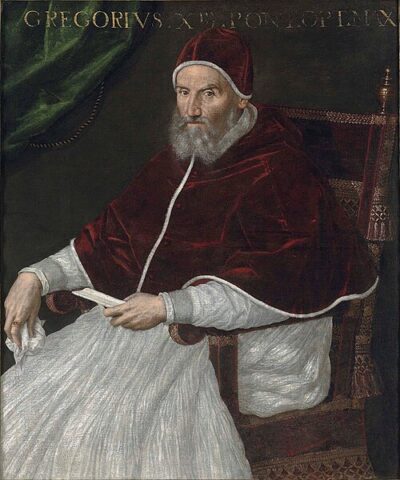
- Gregory XIII
- Wikipedias with a page
- 210
Wikidata item Q12138 (wikidata.org/wiki/Q12138), public domain (CC0). Copied 2026-11-17.
What Wikipedia says · copied November 17, 2026 · revision 1384274333
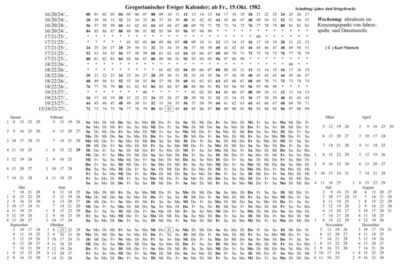
The Gregorian calendar is the calendar currently used in most parts of the world. It went into effect in October 1582 following the papal bull Inter gravissimas issued by Pope Gregory XIII, which introduced it as a modification of, and replacement for, the Julian calendar. The principal change was to space leap years slightly differently to make the average calendar year 365+97⁄400, or 365.2425, days long rather than the Julian calendar's 365+1⁄4 days, thus more closely approximating the 365.2422-day tropical, or solar, year that is determined by the Earth's revolution around the Sun.
The rule for leap years is that every year divisible by four is a leap year, except for years that are divisible by 100 but not also divisible by 400. For example, 1800 and 1900 were not leap years, but 1600 and 2000 were.
There were two reasons to establish the Gregorian calendar. First, the Julian calendar was based on the estimate that the average solar year is exactly 365.25 days long, an overestimate of a little under one day per century, and thus has a leap year every four years without exception. The Gregorian reform shortened the average (calendar) year by 0.0075 days to stop the drift of the calendar with respect to the equinoxes. Second, in the years since the First Council of Nicaea in AD 325, the excess leap days introduced by the Julian algorithm had caused the calendar to drift such that the March equinox was occurring well before its nominal 21 March date. This date was important to the Christian churches because it is fundamental to the calculation of the date of Easter. To reinstate the association, the reform advanced the date by 10 days: Thursday 4 October 1582 was followed by Friday 15 October 1582. In addition, the reform also altered the lunar cycle used by the Church to calculate the date for Easter, because astronomical new moons were occurring four days before the calculated dates.
The reform was adopted initially by the Catholic countries of Europe and their overseas possessions. Over the next three centuries, the Protestant and Eastern Orthodox countries also gradually moved to what they called the "Improved calendar", with Greece being the last European country to adopt the calendar (for civil use only) in 1923. However, many Orthodox churches continue to use the Julian calendar for religious rites and the dating of major feasts. To unambiguously specify a date during the transition period (in contemporary documents or in history texts), both notations were given, tagged as "Old Style" or "New Style" as appropriate. During the 20th century, most non-Western countries also adopted the calendar, at least for civil purposes.
From the Wikipedia article “Gregorian calendar” (en.wikipedia.org/wiki/Gregorian_calendar), by its contributors, under CC BY-SA 4.0 (creativecommons.org/licenses/by-sa/4.0/). Copied 2026-11-17; not changed.
Confirmed Two sources agree. Cited One source, and it names where it got it. One source One source, without a reference of its own. Sources disagree The sources disagree. We show the best-supported value and keep theirs below.
Picture: Karl Nimtsch, via Wikimedia Commons · CC BY-SA 3.0