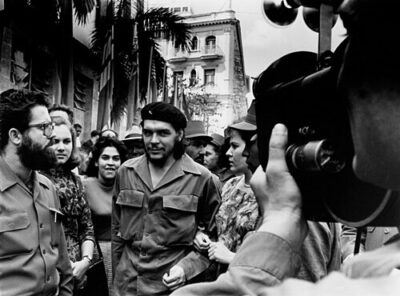
Guerrillero Heroico
Guerrillero Heroico is an iconic photo of Marxist revolutionary Che Guevara by Alberto Korda. It came out in 1960.
- Came out
- March 5, 1960
- Genre
- portrait
- Country of origin
- Cuba
All 4 facts, and where they come from
Facts
4 facts · 0 confirmed by two sources · 0 cited · 4 from one source
Where this comes from
Papalocal keeps its own record. It started from these sources; what each one said is kept here as it was copied, so a change on their side never changes this page by itself. Tap one to read its version.
What Wikidata says · copied November 17, 2026 · revision 2561548451
- Described as
- iconic photo of Marxist revolutionary Che Guevara by Alberto Korda
- Other names
- Heroic Guerrilla Fighter, photo of Che Guevara
- What it is
- photograph
- Genre
- portrait
- Country of origin
- Cuba
- Came out
- March 5, 1960
- Wikipedias with a page
- 42
Wikidata item Q498216 (wikidata.org/wiki/Q498216), public domain (CC0). Copied 2026-11-17.
What Wikipedia says · copied November 17, 2026 · revision 1383890278
Guerrillero Heroico (Latin American Spanish: [ɡeriˈʝeɾo eˈɾojko]; "Heroic Guerrilla Fighter") is a photograph of Argentine revolutionary Che Guevara taken by Alberto Korda. It was captured on 5 March 1960, in Havana, Cuba, at a memorial service for victims of the La Coubre explosion. By the end of the 1960s, the image, in conjunction with Guevara's subsequent actions and eventual assassination, helped solidify the leader as a cultural icon. Korda has said that at the moment he shot the picture, he was drawn to Guevara's facial expression, which showed "absolute implacability" as well as anger and pain. Years later, Korda would say that the photograph showed Che's firm and stoical character. Guevara was 31 years old at the time the photograph was taken.
Emphasizing the image's ubiquitous nature and wide appeal, the Maryland Institute College of Art called the picture a symbol of the 20th century and the world's most famous photograph. Versions of it have been painted, printed, digitized, embroidered, tattooed, silk-screened, sculpted or sketched on nearly every surface imaginable, leading the Victoria and Albert Museum to say that the photograph has been reproduced more than any other image in photography. Jonathan Green, director of the UCR/California Museum of Photography, has speculated that Korda's image has worked its way into languages around the world. It has become an alpha-numeric symbol, a hieroglyph, an instant symbol. It mysteriously reappears whenever there's a conflict. There isn't anything else in history that serves in this way.The history and contemporary global impact of the image is the basis for the 2008 documentary Chevolution, directed by Trisha Ziff, along with the 2009 book Che's Afterlife: The Legacy of an Image by Michael Casey.
From the Wikipedia article “Guerrillero Heroico” (en.wikipedia.org/wiki/Guerrillero_Heroico), by its contributors, under CC BY-SA 4.0 (creativecommons.org/licenses/by-sa/4.0/). Copied 2026-11-17; not changed.
Confirmed Two sources agree. Cited One source, and it names where it got it. One source One source, without a reference of its own. Sources disagree The sources disagree. We show the best-supported value and keep theirs below.
Picture: Wikimedia Commons: Che Guevara - Guerrillero Heroico by Alberto Korda.jpg · See Commons file page