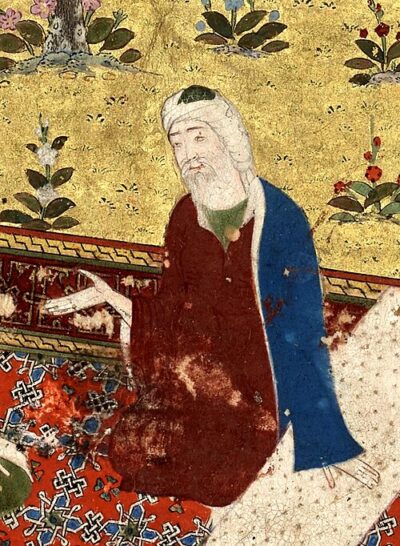
Gulistan
Gulistan is a book written by Persian poet Sa'di Shirazi. It came out in 1258. It was written by Saadi.
- Published
- 1258
- Written by
- Saadi
All 4 facts, and where they come from
Facts
4 facts · 0 confirmed by two sources · 1 cited · 3 from one source
Where this comes from
Papalocal keeps its own record. It started from these sources; what each one said is kept here as it was copied, so a change on their side never changes this page by itself. Tap one to read its version.
What Wikidata says · copied November 17, 2026 · revision 2567086829
- Described as
- book written by Persian poet Sa'di Shirazi
- Other names
- Rose-garden, Rose Garden, Gulistan, the, Rose Garden, the, The Rose Garden, The Gulistan
- What it is
- literary work
- Written by
- Saadi
- Published
- 1258 · 2 references
- Language
- Persian
- Wikipedias with a page
- 32
Wikidata item Q404191 (wikidata.org/wiki/Q404191), public domain (CC0). Copied 2026-11-17.
What Wikipedia says · copied November 17, 2026 · revision 1383144266
The Gulistan (Classical Persian: گُلِستان, romanized: Gulistān, lit. 'Rose Garden'), sometimes spelled Golestan, is a landmark of Persian literature, perhaps its single most influential work of prose. Written in 1258 CE, it is one of two major works of the Persian poet Sheikh Saadi Shirazi, considered one of the greatest medieval Persian poets. It is also one of his most popular books, and has proved deeply influential in the West as well as the East.
The Gulistan is a collection of poems and stories. The aphorism still frequently repeated in the western world, about being sad because one has no shoes until one meets the man who has no feet "whereupon I thanked providence for its bounty to myself" is from the Gulistan.
The minimalist plots of the Gulistan's stories are expressed with precise language and psychological insight, creating a "poetry of ideas" with the concision of mathematical formulas. The book explores virtually every major issue faced by humankind with both an optimistic and a subtly satirical tone. There is much advice for rulers, in this way coming within the mirror for princes genre. But as Eastwick comments in his introduction to the work, there is a common saying in Persian, "Each word of Saadi has seventy-two meanings", and the stories, alongside their entertainment value and practical and moral dimension, frequently focus on the conduct of dervishes and are said to contain Sufi teachings. Idries Shah elaborates further:The place won by the Gulistan as a book of moral uplift invariably given to the literate young has had the effect of establishing a basic Sufic potential in the minds of its readers."
From the Wikipedia article “Gulistan (book)” (en.wikipedia.org/wiki/Gulistan_(book)), by its contributors, under CC BY-SA 4.0 (creativecommons.org/licenses/by-sa/4.0/). Copied 2026-11-17; not changed.
Confirmed Two sources agree. Cited One source, and it names where it got it. One source One source, without a reference of its own. Sources disagree The sources disagree. We show the best-supported value and keep theirs below.
Picture: Wikimedia Commons: The Rose Garden - WDL.tiff · See Commons file page