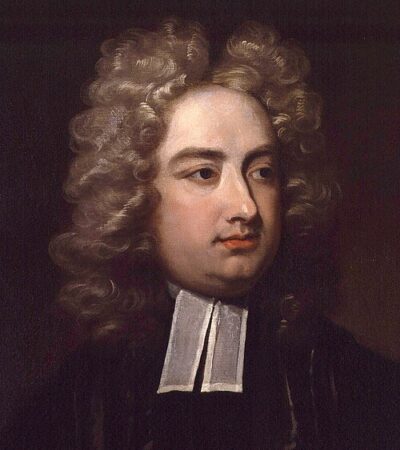
Gulliver's Travels
Gulliver's Travels is a 1726 novel by Jonathan Swift.
- Published
- October 28, 1726
- Written by
- Jonathan Swift
- Genre
- political satire
- Country of origin
- United Kingdom
All 10 facts, and where they come from
Facts
10 facts · 0 confirmed by two sources · 1 cited · 9 from one source
Where this comes from
Papalocal keeps its own record. It started from these sources; what each one said is kept here as it was copied, so a change on their side never changes this page by itself. Tap one to read its version.
What Wikidata says · copied November 17, 2026 · revision 2556788335
- Described as
- 1726 novel by Jonathan Swift
- Other names
- Travels into Several Remote Nations of the World. In Four parts. By Lemuel Gulliver, First a Surgeon, and then a Captain of Several Ships, 1726 Gulliver's Travels
- What it is
- literary work
- Written by
- Jonathan Swift · 1 reference
- Publisher
- Benjamin Motte
- Genre
- political satire; fantasy; nautical fiction; Menippean satire
- Published
- October 28, 1726
- Language
- English
- Country of origin
- United Kingdom
- Wikipedias with a page
- 85
Wikidata item Q181488 (wikidata.org/wiki/Q181488), public domain (CC0). Copied 2026-11-17.
What Wikipedia says · copied November 17, 2026 · revision 1384419430
Gulliver's Travels, originally titled Travels into Several Remote Nations of the World. In Four Parts. By Lemuel Gulliver, First a Surgeon, and then a Captain of Several Ships, is a 1726 satirical prose novel by the Anglo-Irish writer and clergyman Jonathan Swift. It is one of the most famous classics of both English and world literature, and popularised the fictional island of Lilliput. The poet John Gay remarked of the work, "It is universally read, from the cabinet council to the nursery." The novel satirises human nature and the imaginary "travellers' tales" literary subgenre, and it has been adapted for theatrical performances, films, television, and radio over the centuries.
The story is about Lemuel Gulliver, an adventurous Englishman who travels to a series of strange and distant lands, each inhabited by unusual beings that reflect different aspects of human nature and society. In Lilliput, he encounters tiny people engaged in petty political disputes; in Brobdingnag, he is a small man among giants who criticise European customs; in Laputa, he meets impractical intellectuals disconnected from reality; and in the land of the Houyhnhnms, he finds rational horses living peacefully alongside savage human-like creatures called Yahoos. Through these journeys, the novel satirises the flaws of various civilisations.
It is uncertain when Swift began writing the novel, but it is considered to have been an attempt at satirising popular literary genres. By mid 1725, the book was finished and as the work was a political satire, it is very likely that Swift had the manuscript copied by another writer so that his writing could not be used as evidence if a legal case should arise. The novel also has numerous made-up words, referred to as Liliputian language, which critics say might have been inspired by Hebrew. On its publication, the book was an immediate success, and Swift claimed that he had written Gulliver's Travels "to vex the world rather than divert it". Initial public opinions were overwhelmingly positive, with most readers lauding the clever satire, realistic depictions of travel to distant lands, and the political dangers that travelers often face as visitors. However, some critics accused Swift of excessive misanthropy. The English novelist William Thackeray, in particular, described the work as being "blasphemous", saying it was overly harsh in its depiction of human societies.
Gulliver's Travels remains popular in modern times due to its insightful social commentary and political themes. Although the novel is popularly regarded as children's literature, Swift wrote it as a political satire. The book's satire, particularly its elaborate critique of human nature, societal flaws and norms, and personal relations, continues to be studied in literary circles. Since his death, Swift has emerged as the most widely read and translated Irish author, and Gulliver's Travels has retained its position as the most printed book by an Irish writer in libraries, bookstores, and reading cafes worldwide.
From the Wikipedia article “Gulliver's Travels” (en.wikipedia.org/wiki/Gulliver's_Travels), by its contributors, under CC BY-SA 4.0 (creativecommons.org/licenses/by-sa/4.0/). Copied 2026-11-17; not changed.
Confirmed Two sources agree. Cited One source, and it names where it got it. One source One source, without a reference of its own. Sources disagree The sources disagree. We show the best-supported value and keep theirs below.
Picture: Wikimedia Commons: Gullivers travels.jpg · See Commons file page