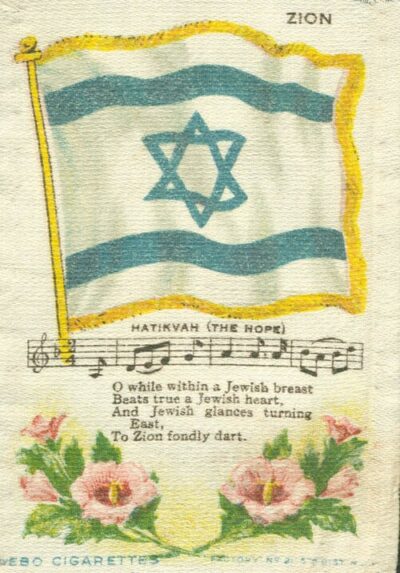
Hatikvah
Hatikvah is a national anthem of Israel. It came out in 1878. It is based on La Mantovana.
- Released
- 1878
All 8 facts, and where they come from
Facts
8 facts · 0 confirmed by two sources · 1 cited · 7 from one source
Where this comes from
Papalocal keeps its own record. It started from these sources; what each one said is kept here as it was copied, so a change on their side never changes this page by itself. Tap one to read its version.
What Wikidata says · copied November 17, 2026 · revision 2565022055
- Described as
- national anthem of Israel
- Other names
- The Hope, Naftali Herz Imber
- What it is
- national anthem; musical work/composition
- Music by
- Samuel Cohen
- Released
- 1878
- Language
- Hebrew
- Based on
- La Mantovana; Tikvateinu · 1 reference
- Country
- Israel
- Wikipedias with a page
- 89
Wikidata item Q130865 (wikidata.org/wiki/Q130865), public domain (CC0). Copied 2026-11-17.
What Wikipedia says · copied November 17, 2026 · revision 1385669040
"Hatikvah" (Hebrew: הַתִּקְוָה [hatikˈva]; lit. 'The Hope') is the national anthem of the State of Israel. A work of 19th-century Zionist Jewish poetry, the romantic composition expresses the desire of Jews in diaspora to return to the Land of Israel in order to establish a Jewish nation-state there. The piece's lyrics are adapted from a work by Naftali Herz Imber, a Jewish poet from Złoczów, Austrian Galicia. Imber wrote the first version of the poem in 1877, when he was hosted by a Jewish scholar in Iași.
From the Wikipedia article “Hatikvah” (en.wikipedia.org/wiki/Hatikvah), by its contributors, under CC BY-SA 4.0 (creativecommons.org/licenses/by-sa/4.0/). Copied 2026-11-17; not changed.
Confirmed Two sources agree. Cited One source, and it names where it got it. One source One source, without a reference of its own. Sources disagree The sources disagree. We show the best-supported value and keep theirs below.
Picture: Center for Jewish History, NYC, via Wikimedia Commons · No restrictions