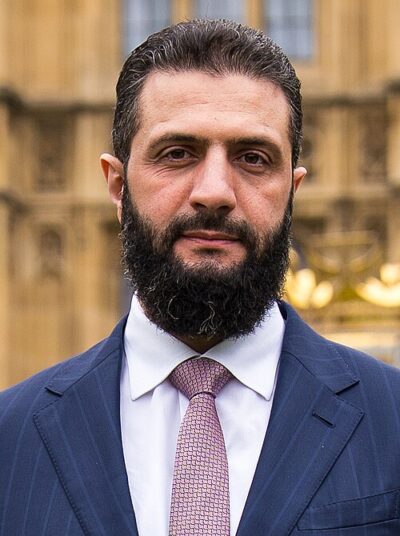
Hay'at Tahrir al-Sham
Hay'at Tahrir al-Sham is a Sunni Islamist militant faction during the Syrian Civil War. It was founded in 2017. Its headquarters are in Idlib. It stands for Islamism, Syrian nationalism and Salafism.
- Founded
- January 28, 2017
- Headquarters
- Idlib
- Country
- Syria
All 13 facts, and where they come from
Facts
13 facts · 0 confirmed by two sources · 1 cited · 12 from one source
Where this comes from
Papalocal keeps its own record. It started from these sources; what each one said is kept here as it was copied, so a change on their side never changes this page by itself. Tap one to read its version.
What Wikidata says · copied November 17, 2026 · revision 2558086457
- Described as
- Sunni Islamist militant faction during the Syrian Civil War
- Other names
- HTS, Organization for the Liberation of the Levant, Hayat Tahrir al-Sham, Tahrir al-Sham
- What it is
- armed organization; terrorist organization; coalition
- Comes after
- Al-Nusra Front
- Founded
- January 28, 2017
- Ended
- January 29, 2025
- Headquarters
- Idlib
- Country
- Syria
- Chair
- Ahmed al-Sharaa (2017–2025); Hashim al-Sheikh · 1 reference
- Ideology
- Islamism · 1 reference; Syrian nationalism; Salafism · 1 reference
- Wikipedias with a page
- 51
Wikidata item Q28540613 (wikidata.org/wiki/Q28540613), public domain (CC0). Copied 2026-11-17.
What Wikipedia says · copied November 17, 2026 · revision 1386224283
Hay'at Tahrir al-Sham (HTS) was a Sunni Islamist political and paramilitary group involved in the Syrian civil war. It was formed on 28 January 2017 as a merger of several armed groups: Jabhat Fatah al-Sham (JFS), Ansar al-Din Front, Jaysh al-Sunna, Liwa al-Haqq and the Nour al-Din al-Zenki Movement. The unification process was held under the initiative of Abu Jaber Sheikh, who had been the second emir of Ahrar al-Sham. HTS, along with other Syrian opposition groups, launched an offensive that led to the fall of the Assad regime on 8 December 2024, more than 13 years after the start of the Syrian revolution.
Proclaiming the nascent organisation as "a new stage in the life of the blessed revolution", Abu Jaber Sheikh urged all factions of the Syrian opposition to unite under its Islamic leadership and wage a "popular jihad" to achieve the objectives of the 2011 revolution, which he characterised as the ousting of the Ba'athist regime and Hezbollah militants from Syrian territories, and the formation of an Islamic government. After the announcement, additional groups and individuals joined. The merged group has been primarily led by Jabhat Fatah al-Sham and former Ahrar al-Sham leaders, although the High Command also has representation from other groups. The Nour al-Din al-Zenki Movement split from Tahrir al-Sham in July 2017, and the Ansar al-Din Front in 2018.
The formation of HTS was followed by a string of assassinations of its supporters. In response, HTS launched a successful crackdown on al-Qaeda loyalists, which cemented its power in Idlib. HTS then pursued a "Syrianisation" programme, focused on establishing a stable civilian administration that provides services and connects to humanitarian organizations in addition to maintaining law and order. Tahrir al-Sham's strategy was based on expanding its territorial control in Syria, establishing governance and mobilising popular support. In 2017, HTS permitted Turkish troops to patrol North-West Syria as part of a ceasefire brokered through the Astana negotiations. Its policies brought it into conflict with Hurras al-Din, al-Qaeda's Syrian wing, including militarily. HTS had an estimated 6,000–15,000 members in 2022.
From 2017 to 2024, HTS gave allegiance to the Syrian Salvation Government (SSG), which served as its civilian administration in Idlib Governorate. While the organisation officially adhered to the Salafi school, the High Council of Fatwa of the Syrian Salvation Government – to which it is religiously beholden – consisted of ulema from Ash'arite and Sufi traditions as well. In its legal system and educational curriculum, HTS implemented Shafi'ite thought and taught the importance of the four classical Sunni madhahib (schools of law) in Islamic jurisprudence.
From 2021 to 2024, HTS was the most powerful military faction within the Syrian opposition. Τhe organisation was designated a terrorist group by United Nations Security Council Resolution 2254, which classified the group's precursor, Jabhat al-Nusra. After the fall of Damascus in December 2024, the SSG was replaced by the Syrian transitional government. On 29 January 2025, Hassan Abdul Ghani, spokesperson for the Military Operations Command, announced the dissolution of HTS and several armed factions and declared that they would become part of "state institutions". Throughout 2025 and 2026, a number of countries revoked their designations of HTS as a terrorist organization, including the United States, UK, Canada, and Japan. The UN Security Council and European Union also lifted sanctions on the organization.
From the Wikipedia article “Hay'at Tahrir al-Sham” (en.wikipedia.org/wiki/Hay'at_Tahrir_al-Sham), by its contributors, under CC BY-SA 4.0 (creativecommons.org/licenses/by-sa/4.0/). Copied 2026-11-17; not changed.
Confirmed Two sources agree. Cited One source, and it names where it got it. One source One source, without a reference of its own. Sources disagree The sources disagree. We show the best-supported value and keep theirs below.
Picture: Wikimedia Commons: Hayat Tahrir al-Sham storms Mushairfa (helmet camera).png · See Commons file page