Haystacks
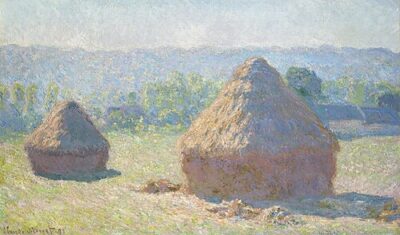
Haystacks is a series of paintings by Claude Monet.
- Created by
- Claude Monet
All 2 facts, and where they come from
Facts
2 facts · 0 confirmed by two sources · 0 cited · 2 from one source
Where this comes from
Papalocal keeps its own record. It started from these sources; what each one said is kept here as it was copied, so a change on their side never changes this page by itself. Tap one to read its version.
What Wikidata says · copied November 17, 2026 · revision 2569306695
- Described as
- series of paintings by Claude Monet
- What it is
- painting series
- Created by
- Claude Monet
- Wikipedias with a page
- 21
Wikidata item Q557000 (wikidata.org/wiki/Q557000), public domain (CC0). Copied 2026-11-17.
What Wikipedia says · copied November 17, 2026 · revision 1376785485
Haystacks is the common English title for a series of impressionist paintings by Claude Monet. The principal subject of each painting in the series is stacks of harvested wheat (or possibly barley or oats: the original French title, Les Meules à Giverny, simply means The Stacks at Giverny, obviously concerning stacks of straw). The title refers primarily to a twenty-five canvas series (Wildenstein Index Numbers 1266–1290) which Monet began near the end of the summer of 1890 and continued through the following spring, though Monet also produced five earlier paintings using this same stack subject. A precursor to the series is the 1884 Haystack Near Giverny (Pushkin Museum).
The series is famous for the way in which Monet repeated the same subject to show the differing light and atmosphere at different times of day, across the seasons and in many types of weather.
The series is among Monet's most notable works. The largest Haystacks collections are held at the Musée d'Orsay and Musée Marmottan Monet in Paris, and in the Art Institute of Chicago. The Art Institute of Chicago collection includes six of the twenty-five Haystacks.
Other collections include the Museum of Fine Arts, Boston, the Metropolitan Museum and Museum of Modern Art in New York, the National Museum of Western Art in Tokyo, and the Musée de l'Orangerie in Paris.
Other museums that hold parts of this series include the Getty Center in Los Angeles, the Hill-Stead Museum in Farmington, Connecticut (which also has one of five from the earlier 1888–89 harvest), the Scottish National Gallery, the National Gallery (England), Museum Barberini, Minneapolis Institute of Arts, Kunsthaus Zürich, Tel Aviv Museum of Art and the Shelburne Museum, Vermont. Private collections hold the remaining Haystacks paintings.
From the Wikipedia article “Haystacks (Monet series)” (en.wikipedia.org/wiki/Haystacks_(Monet_series)), by its contributors, under CC BY-SA 4.0 (creativecommons.org/licenses/by-sa/4.0/). Copied 2026-11-17; not changed.
Confirmed Two sources agree. Cited One source, and it names where it got it. One source One source, without a reference of its own. Sources disagree The sources disagree. We show the best-supported value and keep theirs below.
Picture: Claude Monet, via Wikimedia Commons · Public domain