
Hezbollah
Hezbollah is an Iranian-backed Shia Islamist political party and terrorist organization in Lebanon. It was founded in 1982 by Mohammad Hussein Fadlallah, Ali Akbar Mohtashamipur and Imad Mughniyah. Its headquarters are in Beirut. It stands for Islamism, anti-Zionism and anti-imperialism.
- Country
- Lebanon
- Founded
- 1982
- Ideology
- Islamism
All 16 facts, and where they come from
Facts
16 facts · 0 confirmed by two sources · 4 cited · 12 from one source
Where this comes from
Papalocal keeps its own record. It started from these sources; what each one said is kept here as it was copied, so a change on their side never changes this page by itself. Tap one to read its version.
What Wikidata says · copied November 17, 2026 · revision 2566805310
- Described as
- Iranian-backed Shia Islamist political party and terrorist organization in Lebanon
- Other names
- Lebanese Hizbullah, Lebanese Hezbollah, Hizbullah, Hizballah, Hizbollah
- What it is
- political party; armed organization; terrorist organization · 1 reference
- Country of origin
- Lebanon
- Founded
- 1982
- Founded by
- Mohammad Hussein Fadlallah; Ali Akbar Mohtashamipur; Imad Mughniyah
- Headquarters
- Beirut (–2024)
- Country
- Lebanon · 1 reference
- Ideology
- Islamism · 1 reference; anti-Zionism; anti-imperialism · 1 reference; Arab nationalism
- Named after
- Ḥizb Allāh
- Official website
- https://www.moqawama.org.lb
- Wikipedias with a page
- 128
Wikidata item Q41053 (wikidata.org/wiki/Q41053), public domain (CC0). Copied 2026-11-17.
What Wikipedia says · copied November 17, 2026 · revision 1386107247
Hezbollah is a Lebanese Shia Islamist political party with an active paramilitary wing. Its military and security activities have been prohibited by the Lebanese government since March 2026, amid the 2026 Lebanon war. Hezbollah's paramilitary wing is the Jihad Council, and its political wing is the Loyalty to the Resistance Bloc party in the Lebanese Parliament. Its armed strength was assessed to be equivalent to that of a medium-sized army in 2016.
Hezbollah was founded in 1982 by Lebanese Shiite clerics in close cooperation with Iran. It emerged in the context of the Lebanese civil war, the collapse of central authority, Iran's strategic interests in Lebanon, and the Israeli invasion of Lebanon. The movement's formation was shaped by the Iranian Revolution of 1979 and Ayatollah Ruhollah Khomeini's model of Islamic governance. Hezbollah subsequently established strong ties with Iran as part of the "Axis of Resistance". The group was initially supported by 1,500 Islamic Revolutionary Guard Corps (IRGC) instructors, who helped unify various Lebanese Shia factions under Hezbollah's leadership. Hezbollah's 1985 manifesto outlined its key objectives, which include expelling Western influence from the region, destroying Israel, pledging allegiance to Iran's supreme leader, and establishing an Islamic government influenced by Iran's political ideology. However, the manifesto also emphasised Lebanese self-determination. Throughout the 1980s and 1990s, Hezbollah fought against Israeli forces and the South Lebanon Army (SLA), eventually leading to Israel's withdrawal from southern Lebanon in 2000. Hezbollah also played a prominent role in the 2006 Lebanon War and later became involved in the Syrian civil war, where it fought alongside the government of Bashar al-Assad against the ultimately victorious Syrian opposition forces.
In 2009, Hezbollah issued a new manifesto to oppose political sectarianism, broaden its appeal to non-Islamic movements, and promote a national unity government. The updated manifesto retained the same basic approach to foreign policy, emphasising what it characterizes as 'hegemonic strategies' of the U.S. and portraying Israel as its forward base for dominating the region.
Since the 1990s, Hezbollah has grown into a significant political force in Lebanon. The group operates a vast social services network, including schools and hospitals, and runs a satellite TV station, Al-Manar. Politically, Hezbollah's Loyalty to the Resistance Bloc holds 15 seats in the Lebanese Parliament, making it a powerful player in Lebanon's government. However, the group's influence has led to growing domestic criticism. Following the 2020 Beirut port explosion, Hezbollah was accused of obstructing efforts to hold those responsible accountable, contributing to a decline in public trust. A 2024 Arab Barometer survey found that 55% of Lebanese have "no trust at all" in Hezbollah, although it remains popular among the Shia population.
Despite calls for disarmament under United Nations Security Council resolutions, Hezbollah has expanded its military capabilities. In 2013, its armed wing is considered stronger than the Lebanese Armed Forces, making it one of the most powerful non-state actors in the world. Hezbollah leader Hassan Nasrallah declared in 2021 that the group had 100,000 fighters. Hezbollah has been involved in several high-profile attacks; it is believed to be responsible for the bombing of the US embassy and the US and French barracks bombings in Beirut in 1983, the assassination of Rafic Hariri in 2005, as well as later attacks, including bombings and hijackings. While Hezbollah has been regarded as a resistance movement by some scholars, the entire organisation, or its military wing alone, has been designated as a terrorist group by at least 28 countries as of April 2026, including most Western countries.
Since October 2023, Hezbollah has been at war with Israel. During this war, Nasrallah was assassinated after 32 years of leading the group, along with other key members of Hezbollah leadership. The conflict has led to the 2024 Lebanon War, which saw Southern Lebanon invaded by Israel, followed by a ceasefire. On 7 August 2025, in a government meeting specifically addressing the disarmament of Hezbollah, the majority of the government voted to approve the decision. The Lebanese Army was tasked to create a plan ensuring that only the state has control over weapons in Lebanon. The decision is based on a US plan to disarm Hezbollah. On 5 September, the Lebanese cabinet approved the Homeland Shield Plan, the LAF's roadmap for the disarmament of all militias in Lebanon and specifically Hezbollah. On 2 March 2026, Lebanese Prime Minister Nawaf Salam stated that the organisation's military actions range outside of Lebanese law.
From the Wikipedia article “Hezbollah” (en.wikipedia.org/wiki/Hezbollah), by its contributors, under CC BY-SA 4.0 (creativecommons.org/licenses/by-sa/4.0/). Copied 2026-11-17; not changed.
Confirmed Two sources agree. Cited One source, and it names where it got it. One source One source, without a reference of its own. Sources disagree The sources disagree. We show the best-supported value and keep theirs below.
People connected 5
Party members
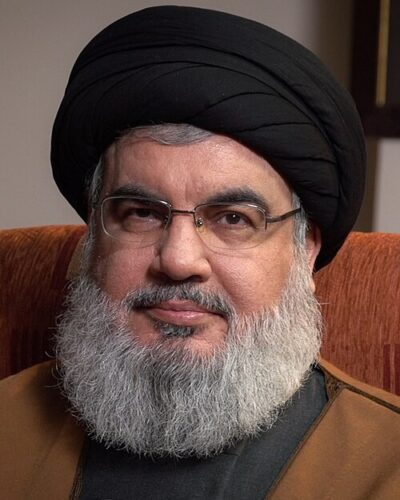 Hasan Nasrallah (1982–2024)Leader of Hezbollah (1960-2024)
 Naim QassemSecretary-General of Hezbollah
 Hashem Safieddine (2001–2024)Lebanese politician (1964-2024)
 Imad MughniyahLebanese militant leader (1962–2008)
 Abbas al-MusawiLebanese Shia cleric and co-founder and Secretary General of Hezbollah (1952-1992)
