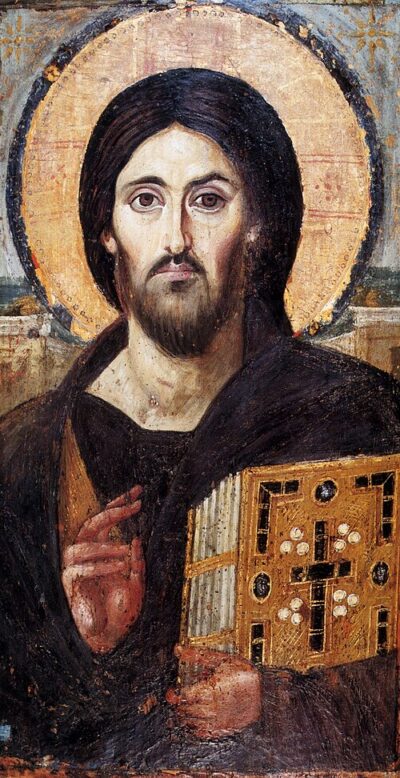
Holy Trinity
Holy Trinity is a Christian conception of God as consisting of three persons (hypostases) — the Father, the Son, and the Holy Spirit — sharing the same substance (ousia).
All 3 facts, and where they come from
Facts
3 facts · 0 confirmed by two sources · 0 cited · 3 from one source
Where this comes from
Papalocal keeps its own record. It started from these sources; what each one said is kept here as it was copied, so a change on their side never changes this page by itself. Tap one to read its version.
What Wikidata says · copied November 16, 2026 · revision 2567783671
- Described as
- Christian conception of God as consisting of three persons (hypostases) — the Father, the Son, and the Holy Spirit — sharing the same substance (ousia)
- Other names
- Father, Son, Holy Ghost, the Father, the Son, and the Holy Ghost, Father, Son, Holy Spirit, the Father, the Son, and the Holy Spirit, Christian Trinity, Trinitarian God, Trinity
- What it is
- Christian dogma; attributes of God in Christianity; monad
- Wikipedias with a page
- 125
Wikidata item Q37090 (wikidata.org/wiki/Q37090), public domain (CC0). Copied 2026-11-16.
What Wikipedia says · copied November 16, 2026 · revision 1385096997
The Trinity (Latin: Trinitas, lit. 'triad', from trinus 'threefold') is a Christian doctrine concerning the nature of God. It defines one God as existing in three divine persons: God the Father, God the Son (Jesus Christ), and God the Holy Spirit. They are considered to be coeternal and consubstantial, constituting three distinct persons (hypostases) that share one essence/substance/nature (homoousion).
The Fourth Lateran Council, an ecumenical council held by the Catholic Church in 1215 AD, declared that the Father begets, the Son is begotten, and the Holy Spirit proceeds. In this context, the single essence/nature defines what God is, while the three persons define who God is. The doctrine expresses both a distinction between, and an indissoluble unity of, the three personages. The process of creation and grace is viewed as a single shared action of the three divine persons, who each manifest their unique attributes. This is expressed in the statements that everything is "from the Father", "through the Son", and "in the Holy Spirit".
The doctrine is called Trinitarianism, and its adherents are Trinitarians. Most major Christian denominations today are Trinitarian. Its opponents are called nontrinitarians (or antitrinitarians), who are considered heretical non-Christians by many Trinitarians. Nontrinitarian positions include Unitarianism, binitarianism and modalism. The theological study of the Trinity is called triadology or Trinitarian theology.
The Trinity was developed by the early Christians (late-2nd century AD onwards) and fathers of the Church, to describe the relationship between Jesus and God in their scriptures and prior traditions. The doctrine was firmly established by the 4th century First Council of Nicaea and First Council of Constantinople, which made it an integral part of the creed. According to James W. Barker and C. Kavin Rowe there is support for Trinitarianism in the Bible, particularly the New Testament books of the Pauline epistles and the Gospels. These present an implicitly triadic understanding of God and contain several Trinitarian formulas.
From the Wikipedia article “Trinity” (en.wikipedia.org/wiki/Trinity), by its contributors, under CC BY-SA 4.0 (creativecommons.org/licenses/by-sa/4.0/). Copied 2026-11-16; not changed.
Confirmed Two sources agree. Cited One source, and it names where it got it. One source One source, without a reference of its own. Sources disagree The sources disagree. We show the best-supported value and keep theirs below.
Picture: Wikimedia Commons: Giovanni Battista Tiepolo 016.jpg · See Commons file page