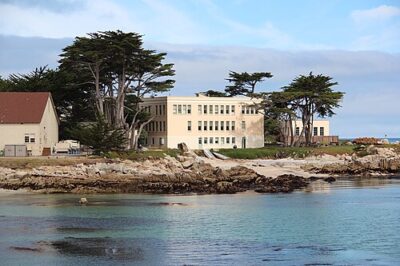
Hopkins Marine Station
Hopkins Marine Station is a marine research labratory. It was founded in 1891.
- Founded
- 1891
- Country
- United States
All 12 facts, and where they come from
Facts
12 facts · 0 confirmed by two sources · 6 cited · 6 from one source
Where this comes from
Papalocal keeps its own record. It started from these sources; what each one said is kept here as it was copied, so a change on their side never changes this page by itself. Tap one to read its version.
What Wikidata says · copied November 17, 2026 · revision 2540507942
- Described as
- marine research labratory
- Other names
- Hopkins Seaside Laboratory, Hopkins Labratory
- What it is
- laboratory; building; organization · 1 reference
- Founded
- 1891 · 1 reference
- Located in
- Pacific Grove
- Country
- United States · 1 reference
- Part of
- Stanford University · 1 reference; Stanford Doerr School of Sustainability (2022–)
- Field
- oceanography · 1 reference; marine biology · 1 reference
- Named after
- Timothy Hopkins
- Official website
- https://hopkinsmarinestation.stanford.edu/
- Wikipedias with a page
- 2
Wikidata item Q14682339 (wikidata.org/wiki/Q14682339), public domain (CC0). Copied 2026-11-17.
What Wikipedia says · copied November 17, 2026 · revision 1362854570
Hopkins Marine Station is the marine laboratory of Stanford University. It is located 90 miles (145 km) south of the university's main campus, in Pacific Grove, California (United States) on the Monterey Peninsula, adjacent to the Monterey Bay Aquarium. It is home to ten research laboratories and a fluctuating population of graduate and undergraduate students. It has also been used for archaeological exploration, including of the Chinese-American fishing village that existed on the site before burning down in 1906.
From the Wikipedia article “Hopkins Marine Station” (en.wikipedia.org/wiki/Hopkins_Marine_Station), by its contributors, under CC BY-SA 4.0 (creativecommons.org/licenses/by-sa/4.0/). Copied 2026-11-17; not changed.
Confirmed Two sources agree. Cited One source, and it names where it got it. One source One source, without a reference of its own. Sources disagree The sources disagree. We show the best-supported value and keep theirs below.
Picture: Thomson200, via Wikimedia Commons · CC0