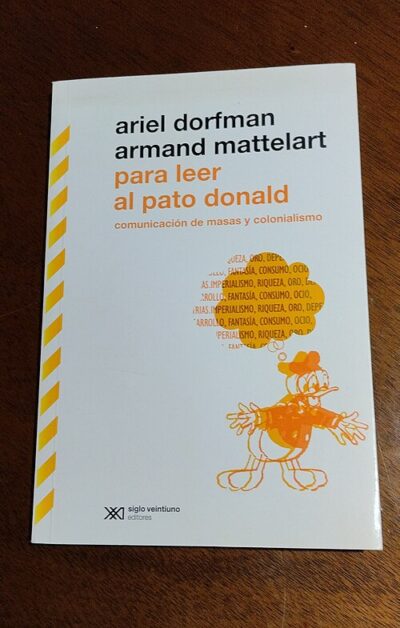
How to Read Donald Duck
How to Read Donald Duck is a 1971 book by Ariel Dorfman & Armand Mattelart.
- Published
- 1971
- Written by
- Ariel Dorfman
- Country of origin
- Chile
All 6 facts, and where they come from
Facts
6 facts · 0 confirmed by two sources · 0 cited · 6 from one source
Where this comes from
Papalocal keeps its own record. It started from these sources; what each one said is kept here as it was copied, so a change on their side never changes this page by itself. Tap one to read its version.
What Wikidata says · copied November 17, 2026 · revision 2440934089
- Described as
- 1971 book by Ariel Dorfman & Armand Mattelart
- Other names
- How to read Donald Duck : imperialist ideology in the Disney comic
- What it is
- literary work
- Written by
- Ariel Dorfman; Armand Mattelart
- Published
- 1971
- Language
- Spanish
- Country of origin
- Chile · 1 reference
- Wikipedias with a page
- 5
Wikidata item Q5918732 (wikidata.org/wiki/Q5918732), public domain (CC0). Copied 2026-11-17.
What Wikipedia says · copied November 17, 2026 · revision 1384321413
How to Read Donald Duck (Spanish: Para leer al Pato Donald) is a 1971 book-length essay by Ariel Dorfman and Armand Mattelart that critiques Disney comics from a Marxist point of view as capitalist propaganda for American corporate and cultural imperialism. It was first published in Chile in 1971, became a bestseller throughout Latin America and is still considered a seminal work in cultural studies. It was reissued in August 2018 to a general audience in the United States, with a new introduction by Dorfman, by OR Books.
From the Wikipedia article “How to Read Donald Duck” (en.wikipedia.org/wiki/How_to_Read_Donald_Duck), by its contributors, under CC BY-SA 4.0 (creativecommons.org/licenses/by-sa/4.0/). Copied 2026-11-17; not changed.
Confirmed Two sources agree. Cited One source, and it names where it got it. One source One source, without a reference of its own. Sources disagree The sources disagree. We show the best-supported value and keep theirs below.
Picture: Adrimarci, via Wikimedia Commons · CC BY 4.0