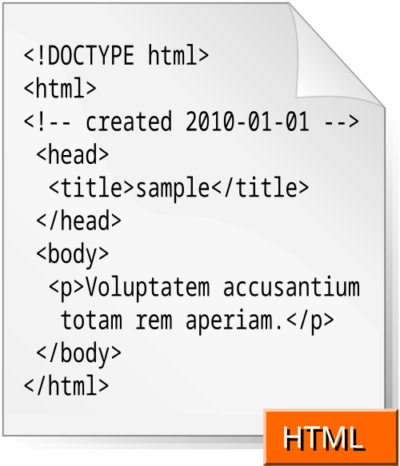
HTML
HTML is a family of markup languages for displaying content in a web browser. It came out in 1993. It was made by World Wide Web Consortium, the Internet Engineering Task Force and Web Hypertext Application Technology Working Group. It is based on Standard Generalized Markup Language.
- Released
- 1993
- Came out
- 1989
- Made by
- World Wide Web Consortium
All 11 facts, and where they come from
Facts
11 facts · 0 confirmed by two sources · 3 cited · 8 from one source
Where this comes from
Papalocal keeps its own record. It started from these sources; what each one said is kept here as it was copied, so a change on their side never changes this page by itself. Tap one to read its version.
What Wikidata says · copied November 17, 2026 · revision 2567738940
- Described as
- family of markup languages for displaying content in a web browser
- Other names
- Hyper Text Markup Language, HyperText Markup Language
- What it is
- markup language; file format; W3C Recommendation
- Made by
- World Wide Web Consortium; Internet Engineering Task Force; Web Hypertext Application Technology Working Group
- Released
- 1993
- Based on
- Standard Generalized Markup Language · 1 reference
- Came out
- 1989 · 2 references
- Country
- United Kingdom
- Official website
- https://www.w3.org/html/
- Wikipedias with a page
- 186
Wikidata item Q8811 (wikidata.org/wiki/Q8811), public domain (CC0). Copied 2026-11-17.
What Wikipedia says · copied November 17, 2026 · revision 1385144735
Hypertext Markup Language (HTML) is the standard markup language for documents designed to be displayed in a web browser. It defines the content and structure of web content. It is often assisted by technologies such as Cascading Style Sheets (CSS) and scripting languages such as JavaScript.
Web browsers receive HTML documents from a web server or from local storage and render the documents into multimedia web pages. HTML describes the structure of a web page semantically and originally included cues for its appearance.
HTML elements are the building blocks of HTML pages. With HTML constructs, images and other objects such as interactive forms may be embedded into the rendered page. HTML provides a means to create structured documents by denoting structural semantics for text such as headings, paragraphs, lists, links, quotes, and other items. HTML elements are delineated by tags, written using angle brackets. Tags such as <img> and <input> directly introduce content into the page. Other tags such as <p> and its corresponding closing tag </p> surround and provide information about document text and may include sub-element tags. Browsers do not display the HTML tags, but use them to interpret the content of the page.
HTML can embed programs written in a scripting language such as JavaScript, which affects the behavior and content of web pages. The inclusion of CSS defines the look and layout of content. The World Wide Web Consortium (W3C), former maintainer of the HTML and current maintainer of the CSS standards, has encouraged the use of CSS over explicit presentational HTML since 1997.
From the Wikipedia article “HTML” (en.wikipedia.org/wiki/HTML), by its contributors, under CC BY-SA 4.0 (creativecommons.org/licenses/by-sa/4.0/). Copied 2026-11-17; not changed.
Confirmed Two sources agree. Cited One source, and it names where it got it. One source One source, without a reference of its own. Sources disagree The sources disagree. We show the best-supported value and keep theirs below.
Picture: Dreftymac, via Wikimedia Commons · CC BY-SA 2.5