Il viaggio a Reims
Il viaggio a Reims is an opera by Gioachino Rossini.
- Released
- 19th century
- Genre
- opera buffa
- Country of origin
- Italy
All 7 facts, and where they come from
Facts
7 facts · 0 confirmed by two sources · 2 cited · 5 from one source
Where this comes from
Papalocal keeps its own record. It started from these sources; what each one said is kept here as it was copied, so a change on their side never changes this page by itself. Tap one to read its version.
What Wikidata says · copied November 17, 2026 · revision 2487380165
- Described as
- opera by Gioachino Rossini
- Other names
- Il viaggio a Reims ossia L'albergo del giglio d'oro
- What it is
- dramatico-musical work
- Music by
- Gioachino Rossini · 1 reference
- Genre
- opera buffa; opera · 1 reference
- Released
- 19th century
- Language
- Italian
- Country of origin
- Italy
- Wikipedias with a page
- 20
Wikidata item Q470983 (wikidata.org/wiki/Q470983), public domain (CC0). Copied 2026-11-17.
What Wikipedia says · copied November 17, 2026 · revision 1380572357
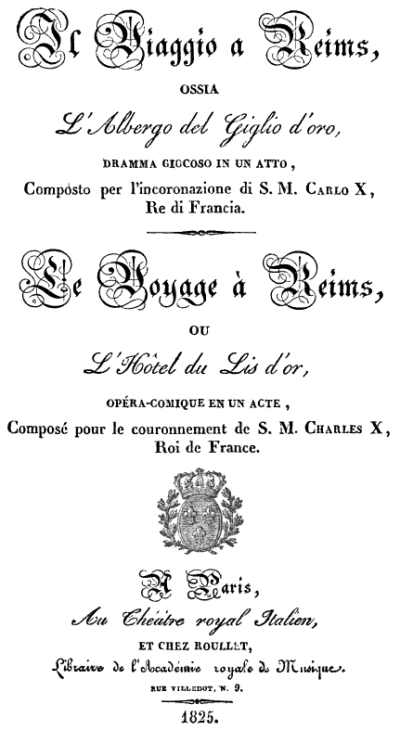
Il viaggio a Reims, ossia L'albergo del giglio d'oro (The Journey to Reims, or The Hotel of the Golden Fleur-de-lis) is an operatic dramma giocoso, originally performed in three acts, by Gioachino Rossini to an Italian libretto by Luigi Balocchi, based in part on the 1807 novel Corinne ou l'Italie by Germaine de Staël.
Rossini's last opera in the Italian language (all of his later works were in French) premiered under the title Le voyage à Reims, ou l'Hôtel du Lys-d'Or. It was commissioned to celebrate the coronation of French King Charles X in Reims in May 1825 and has been acclaimed as one of Rossini's finest compositions. A demanding work, it requires 14 soloists (three sopranos, one contralto, two tenors, four baritones, and four basses). At its premiere, it was sung by the greatest voices of the day.
Since the opera was written for a specific occasion, with a plot about European aristocrats, officers – and one poetess – en route to join in the French coronation festivities that the opera itself was composed for, Rossini never intended it to have a life beyond a few performances in Paris. He later re-used about half of the music in Le comte Ory.
Il viaggio a Reims does not have an overture. Its so-called overture, derived from a set of dances in Le siège de Corinthe (1826), one of which Rossini had reworked from the dances in the finale to Il viaggio a Reims, is a twentieth-century invention or an erroneous attribution. It was published in Milan, in 1938, in a revision by Giuseppe Piccioli, which was first performed in the Teatro alla Scala, on 5 November 1938, conducted by Richard Strauss. It was later also recorded repeatedly as the alleged overture of Il viaggio a Reims, until it was finally possible to reconstruct the original score of the opera. The attributed overture remains one of Rossini's most recorded works.
From the Wikipedia article “Il viaggio a Reims” (en.wikipedia.org/wiki/Il_viaggio_a_Reims), by its contributors, under CC BY-SA 4.0 (creativecommons.org/licenses/by-sa/4.0/). Copied 2026-11-17; not changed.
Confirmed Two sources agree. Cited One source, and it names where it got it. One source One source, without a reference of its own. Sources disagree The sources disagree. We show the best-supported value and keep theirs below.
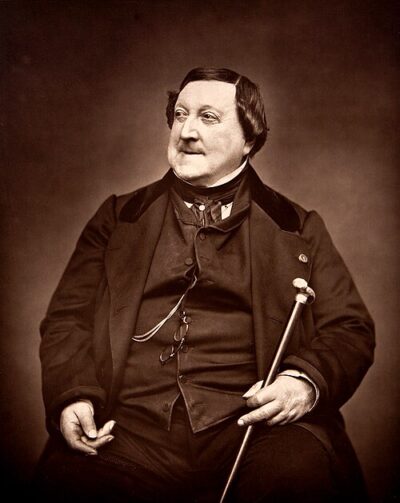
Picture: Gioachino Rossini, Giuseppe Luigi Balocchi, via Wikimedia Commons · Public domain