Independent Order of Odd Fellows
The Independent Order of Odd Fellows is an American fraternal organization. It was founded in 1819 by Thomas Wildey. Its headquarters are in Oslo.
- Founded
- 1819
- Founded by
- Thomas Wildey
- Headquarters
- Oslo
- Country
- United States
All 8 facts, and where they come from
Facts
8 facts · 0 confirmed by two sources · 1 cited · 7 from one source
Where this comes from
Papalocal keeps its own record. It started from these sources; what each one said is kept here as it was copied, so a change on their side never changes this page by itself. Tap one to read its version.
What Wikidata says · copied November 16, 2026 · revision 2564537972
- Described as
- American fraternal organization
- Other names
- IOOF, the Odd Fellows, the Oddfellows, I.O.O.F., Odd Fellows
- What it is
- secret society; fraternal order
- Founded
- 1819 · 1 reference
- Founded by
- Thomas Wildey
- Headquarters
- Oslo · 1 reference
- Located in
- North Carolina
- Country
- United States
- Official website
- https://odd-fellows.org/
- Wikipedias with a page
- 12
Wikidata item Q1425508 (wikidata.org/wiki/Q1425508), public domain (CC0). Copied 2026-11-16.
What Wikipedia says · copied November 16, 2026 · revision 1383324660
The Independent Order of Odd Fellows (IOOF) is a non-political, non-sectarian international fraternal order of Odd Fellowship. It was founded in 1819 by Thomas Wildey in Baltimore, Maryland, United States. Evolving from the Order of Odd Fellows founded in England during the 18th century, the IOOF was originally chartered by the Independent Order of Oddfellows Manchester Unity in England but has operated as an independent organization since 1842, although it maintains an inter-fraternal relationship with the English Order. The order is also known as the Triple Link Fraternity, referring to the order's "Triple Links" symbol, alluding to its motto "Friendship, Love and Truth".
While several unofficial Odd Fellows Lodges had existed in New York City circa 1806–1818, because of its charter relationship, the American Odd Fellows is regarded as being founded with Washington Lodge No 1 in Baltimore at the Seven Stars Tavern on April 26, 1819, by Thomas Wildey along with some associates who assembled in response to an advertisement in the New Republic. The following year, the lodge affiliated with the Independent Order of Oddfellows Manchester Unity and was granted the authority to institute new lodges. Previously, Wildey had joined the Grand United Order of Oddfellows (1798–) in 1804 but followed through with the split of Independent Order of Oddfellows Manchester Unity (1810–) before immigrating to the United States in 1817.
In 1842, after a dispute on authority, the American lodges formed a governing system separate from the English Order, and in 1843 assumed the name Independent Order of Odd Fellows.
Like other fraternities, the Independent Order of Odd Fellows began by limiting their membership to white men only. On September 20, 1851, the IOOF became the first fraternity in the United States to include women when it adopted the "Beautiful Rebekah Degree" by initiative of Schuyler Colfax, later Vice President of the United States. Daughters of Rebekah are an auxiliary organization to the Odd Fellows.
Beyond fraternal and recreational activities, the Independent Order of Odd Fellows promotes the ethic of reciprocity and charity, by implied inspiration of Judeo-Christian ethics. The largest Sovereign Grand Lodge of all fraternal orders of Odd Fellows since the 19th century, it enrolls some 600,000 members from approximately 10,000 lodges into 26 countries, inter-fraternally recognized by the second largest, the British-seated Independent Order of Oddfellows Manchester Unity.
From the Wikipedia article “Independent Order of Odd Fellows” (en.wikipedia.org/wiki/Independent_Order_of_Odd_Fellows), by its contributors, under CC BY-SA 4.0 (creativecommons.org/licenses/by-sa/4.0/). Copied 2026-11-16; not changed.
Confirmed Two sources agree. Cited One source, and it names where it got it. One source One source, without a reference of its own. Sources disagree The sources disagree. We show the best-supported value and keep theirs below.
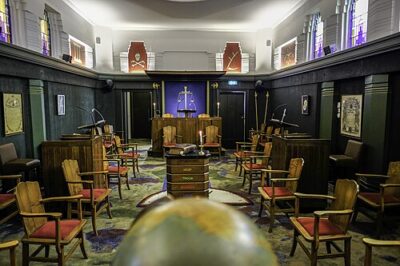
Picture: Hardscarf, via Wikimedia Commons · CC BY-SA 4.0