Institute of Scientific Information on Social Sciences
The Institute of Scientific Information on Social Sciences is a research center in the USSR and Russia. It was founded in 1969. It has 668 employees.
- Founded
- February 7, 1969
- Employees
- 668
- Country
- Russia
All 11 facts, and where they come from
Facts
11 facts · 0 confirmed by two sources · 2 cited · 9 from one source
Where this comes from
Papalocal keeps its own record. It started from these sources; what each one said is kept here as it was copied, so a change on their side never changes this page by itself. Tap one to read its version.
What Wikidata says · copied November 17, 2026 · revision 2504251567
- Described as
- research center in the USSR and Russia
- Other names
- INION, Institute of Scientific Information for Social Sciences, Institut nauchnoĭ informat︠s︡ii po obshchestvennym naukam (Akademii︠a︡ nauk SSSR)
- What it is
- institute; academic library · 1 reference; research center · 1 reference
- Founded
- February 7, 1969
- Located in
- Moscow
- Country
- Russia; Soviet Union
- Chair
- Yuriy Pivovarov
- Employees
- 668 · 1 reference
- Part of
- Ministry of Science and Higher Education · 1 reference
- Official website
- http://inion.ru
- Wikipedias with a page
- 3
Wikidata item Q4201615 (wikidata.org/wiki/Q4201615), public domain (CC0). Copied 2026-11-17.
What Wikipedia says · copied November 17, 2026 · revision 1380968920
Institute of Scientific Information for Social Sciences of the Russian Academy of Sciences, INION RAN (Russian: Институт научной информации по общественным наукам РАН, ИНИОН) is a major center for research in social studies and humanities. The research center was created in 1969 as a successor to the Russian Academy's Fundamental Library of Social Sciences, which was established in 1918.
From the Wikipedia article “Institute of Scientific Information on Social Sciences of the Russian Academy of Sciences” (en.wikipedia.org/wiki/Institute_of_Scientific_Information_on_Social_Sciences_of_the_Russian_Academy_of_Sciences), by its contributors, under CC BY-SA 4.0 (creativecommons.org/licenses/by-sa/4.0/). Copied 2026-11-17; not changed.
Confirmed Two sources agree. Cited One source, and it names where it got it. One source One source, without a reference of its own. Sources disagree The sources disagree. We show the best-supported value and keep theirs below.
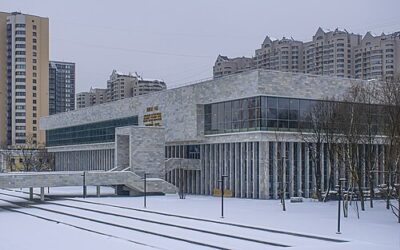
Picture: Dzasohovich, via Wikimedia Commons · CC BY-SA 4.0