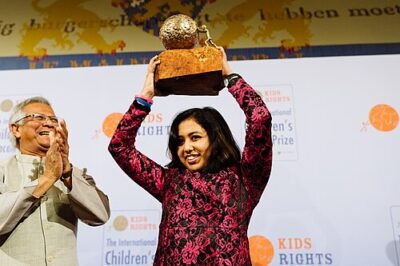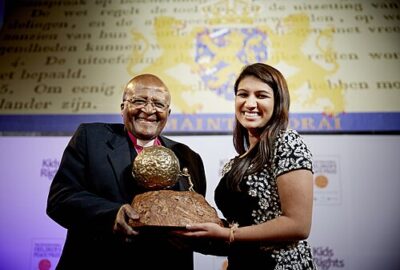
International Children's Peace Prize
International Children's Peace Prize is a peace award. It was created in 2005. It is given by the KidsRights Foundation.
- Given by
- KidsRights Foundation
- Country
- internationality
- Created
- 2005
All 5 facts, and where they come from
Facts
5 facts · 0 confirmed by two sources · 0 cited · 5 from one source
Where this comes from
Papalocal keeps its own record. It started from these sources; what each one said is kept here as it was copied, so a change on their side never changes this page by itself. Tap one to read its version.
What Wikidata says · copied November 17, 2026 · revision 2411928243
- Described as
- award
- What it is
- peace award
- Created
- 2005
- Country
- internationality
- Given by
- KidsRights Foundation
- Official website
- https://childrenspeaceprize.org/
- Wikipedias with a page
- 15
Wikidata item Q727193 (wikidata.org/wiki/Q727193), public domain (CC0). Copied 2026-11-17.
What Wikipedia says · copied November 17, 2026 · revision 1386193254
The International Children's Peace Prize is awarded annually to a child who has made a significant contribution to advocating children's rights and improving the situation of vulnerable children such as orphans, child labourers and children with HIV/AIDS. It holds a reputation as one of the leading youth prizes internationally.
The prize is an initiative of Marc Dullaert, founder of the KidsRights Foundation, an international children's aid and advocacy organisation based in Amsterdam, the Netherlands.
The winner receives a 100,000 euro donation to benefit a charitable project for children, as well as a statuette, the Nkosi, named in honour of Nkosi Johnson. The statuette is of a child pushing a ball, "show[ing] how a child sets the world in motion."
From the Wikipedia article “International Children's Peace Prize” (en.wikipedia.org/wiki/International_Children's_Peace_Prize), by its contributors, under CC BY-SA 4.0 (creativecommons.org/licenses/by-sa/4.0/). Copied 2026-11-17; not changed.
Confirmed Two sources agree. Cited One source, and it names where it got it. One source One source, without a reference of its own. Sources disagree The sources disagree. We show the best-supported value and keep theirs below.
Picture: Anvcomp, via Wikimedia Commons · CC BY-SA 4.0