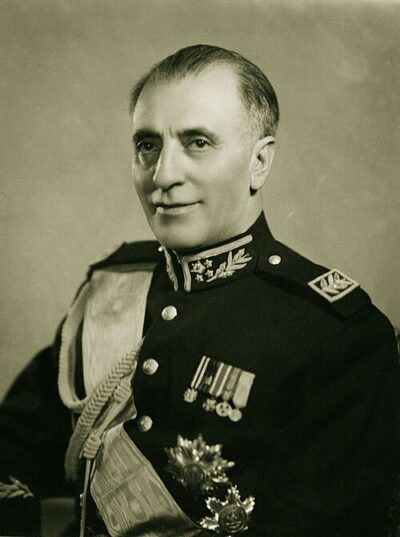
Islamic Republic of Iran Armed Forces
The Islamic Republic of Iran Armed Forces is a combined military forces of Iran. It was founded in 1979. Its headquarters are in Tehran.
- Country
- Iran
- Founded
- 1979
All 4 facts, and where they come from
Facts
4 facts · 0 confirmed by two sources · 0 cited · 4 from one source
Where this comes from
Papalocal keeps its own record. It started from these sources; what each one said is kept here as it was copied, so a change on their side never changes this page by itself. Tap one to read its version.
What Wikidata says · copied November 17, 2026 · revision 2532412718
- Described as
- combined military forces of Iran
- Other names
- Iranian Armed Forces, Military of Iran, mil Iran, Iranian military, Iran Armed Forces, Armed Forces of Iran
- What it is
- armed forces
- Founded
- 1979 · 1 reference
- Headquarters
- Tehran · 1 reference
- Country
- Iran
- Wikipedias with a page
- 47
Wikidata item Q2609135 (wikidata.org/wiki/Q2609135), public domain (CC0). Copied 2026-11-17.
What Wikipedia says · copied November 17, 2026 · revision 1384240436
The Iranian Armed Forces, officially the Islamic Republic of Iran Armed Forces, are the military forces of Iran. It consists of the Islamic Republic of Iran Army (Artesh), the Islamic Revolutionary Guard Corps (IRGC) and the Police Command.
The International Institute for Strategic Studies has estimated since 2023 at least that the regular armed forces, the Artesh, and the Islamic Revolutionary Guard Corps are made up of approximately 570,000 active-duty personnel plus 350,000 reserve and trained personnel that can be mobilized when needed, bringing the country's military manpower to about 920,000 total personnel. These numbers do not include the Police Command or Basij.
The IRGC was established as a separated and parallel military force after the Iranian Revolution of 1979. It was established by a decree of May 1979. The IRGC is tasked with safeguarding the ideological foundations of the Islamic Republic and defending the regime against internal and external threats. It operates its own ground, naval, and air units, as well as the elite Quds Force, which is responsible for extraterritorial operations. The IRGC functions independently of the Artesh and often holds significant influence in strategic, security, and economic affairs within the country.
Both the Armed Forces and the IRGC provide essential security functions for Iran and coordinate regularly. But some rivalry remains, resulting from their uneven access to resources, varying levels of influence with the regime, and inherent overlap in missions and responsibilities. This setup has been criticized for its lack of transparency, limited parliamentary oversight, and its questionable contribution to national defense.
Most of Iran's weapons consists of equipment from its robust domestic rearmament program, which the country launched and its inventory has become increasingly indigenous. Most of the country's military hardware is domestically manufactured, and Iran had become an exporter of arms by the 2000s. Unable to import weapon systems from abroad due to international and U.S. sanctions, and suffering from an increasingly aging air force fleet, Iran has invested considerable funds into an ambitious ballistic and cruise missile program for mid-range strike capability, and has manufactured different types of arms and munitions, including tanks, armoured vehicles and drones, as well as various naval assets and aerial defense systems.
Iran's ballistic missile and space program is an internationally hot political topic over which it has consistently refused to negotiate. Iranian authorities state that the country's missile program is not designed to deliver nuclear payloads, but is used only for surgical strikes. It is therefore not relevant to any nuclear negotiations with the P5+1. The Iranian drone program has also raised concerns in the Western world, especially with proliferation among Iranian-allied forces in the Middle East, as well as exports to countries hostile to the U.S.
All branches of the armed forces fall under the command of the General Staff of the Iranian Armed Forces. The Ministry of Defense and Armed Forces Logistics is responsible for planning logistics and funding of the armed forces and is not involved with in-the-field military operational command. The commander-in-chief of the armed forces is the Supreme Leader.
From the Wikipedia article “Iranian Armed Forces” (en.wikipedia.org/wiki/Iranian_Armed_Forces), by its contributors, under CC BY-SA 4.0 (creativecommons.org/licenses/by-sa/4.0/). Copied 2026-11-17; not changed.
Confirmed Two sources agree. Cited One source, and it names where it got it. One source One source, without a reference of its own. Sources disagree The sources disagree. We show the best-supported value and keep theirs below.
Picture: Wikimedia Commons: Ali Khamenei at Afsari University 2019 3.jpg · See Commons file page
People connected 6
Military branch
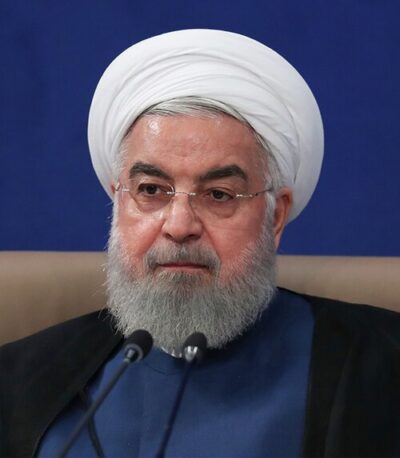 Hassan RouhaniPresident of Iran from 2013 to 2021
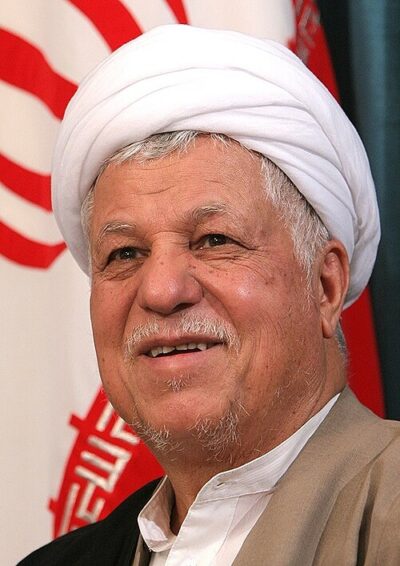 Akbar Hashemi RafsanjaniIranian politician (1934–2017)
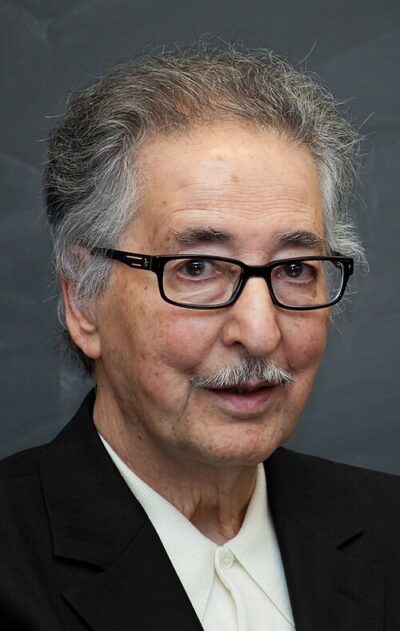 Abolhassan BanisadrIranian politician and economist, and Iran's first President (1933–2021)
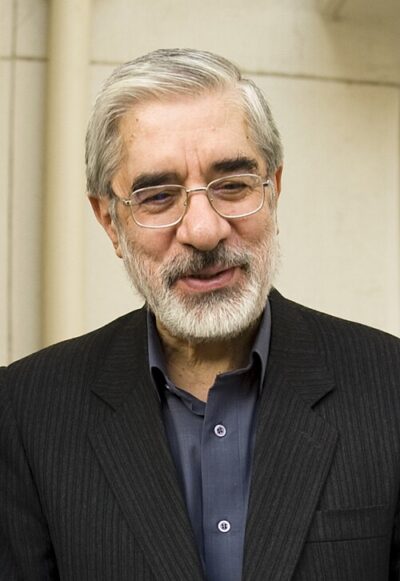 Mir-Hossein MousaviIranian architect and politician
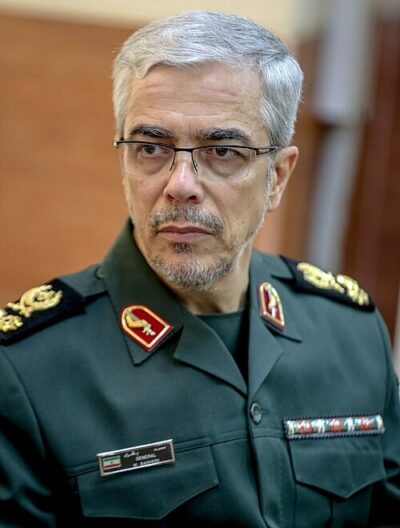 Mohammad BagheriIranian senior military leader