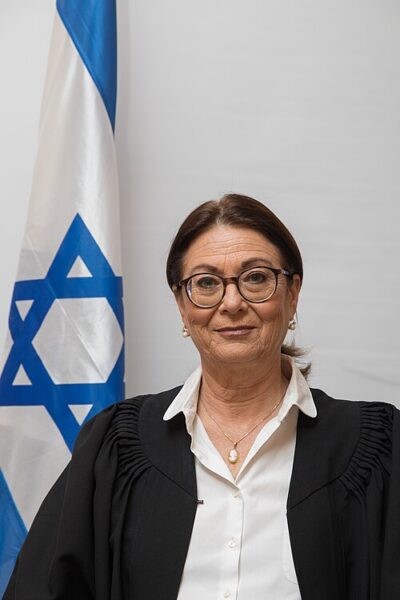
Israeli Supreme Court
The Israeli Supreme Court is the highest court of the State of Israel. It was founded in 1948. Its headquarters are in the Supreme Court of Israel building.
- Founded
- 1948
- Headquarters
- Supreme Court of Israel building
- Country
- Israel
All 8 facts, and where they come from
Facts
8 facts · 0 confirmed by two sources · 0 cited · 8 from one source
Where this comes from
Papalocal keeps its own record. It started from these sources; what each one said is kept here as it was copied, so a change on their side never changes this page by itself. Tap one to read its version.
What Wikidata says · copied November 18, 2026 · revision 2533390948
- Described as
- Highest court of the State of Israel
- What it is
- supreme court
- Founded
- 1948
- Headquarters
- Supreme Court of Israel building
- Country
- Israel
- Chair
- Esther Hayut (2017–2023) · 1 reference; Uzi Vogelman (2023–) · 1 reference
- Office of
- Israel
- Official website
- https://supreme.court.gov.il/
- Wikipedias with a page
- 30
Wikidata item Q399798 (wikidata.org/wiki/Q399798), public domain (CC0). Copied 2026-11-18.
What Wikipedia says · copied November 18, 2026 · revision 1384240590
The Supreme Court of Israel (Hebrew: בֵּית הַמִּשְׁפָּט הָעֶלְיוֹן, romanized: Be(i)t HaMishpat HaElyon, Hebrew acronym Bagatz; Arabic: المحكمة العليا, romanized: al-Maḥkama al-‘Ulyā) is the highest court in Israel. It has ultimate appellate jurisdiction over all other courts, and in some cases original jurisdiction.
The Supreme Court consists of 15 judges appointed by the president of Israel, upon nomination by the Judicial Selection Committee. Once appointed, Judges serve until retirement at the age of 70 unless they resign or are removed from office. The Court is situated in Jerusalem's Givat Ram governmental campus, about half a kilometer from Israel's legislature, the Knesset. By the principle of binding precedent (stare decisis), Supreme Court rulings are binding upon every other court, except itself. Over the years, it has ruled on numerous sensitive issues, some of which relate to the Israeli–Palestinian conflict, the rights of Arab citizens, and discrimination between Jewish groups in Israel.
When ruling as the High Court of Justice (Hebrew: בֵּית מִשְׁפָּט גָּבוֹהַּ לְצֶדֶק, romanized: Be(i)t Mishpat Gavo'ah LeTzedek, also known as its acronym Bagatz, Hebrew: בג"ץ), the court rules on the legality of decisions of State authorities: government decisions, those of local authorities and other bodies and persons performing public functions under the law, and direct challenges to the constitutionality of laws enacted by the Knesset. The court may review actions by state authorities outside of Israel.
Yitzhak Amit is the president of the Supreme Court since 13 February 2025, with Noam Sohlberg as Deputy President since 10 April 2025. The Supreme Court has been a main focus of incumbent justice minister Yariv Levin, with an attempt in 2023 to limit the power of the Supreme Court failing and Levin refusing to meet Amit since 2025 in what has been branded as a constitutional crisis.
From the Wikipedia article “Supreme Court of Israel” (en.wikipedia.org/wiki/Supreme_Court_of_Israel), by its contributors, under CC BY-SA 4.0 (creativecommons.org/licenses/by-sa/4.0/). Copied 2026-11-18; not changed.
Confirmed Two sources agree. Cited One source, and it names where it got it. One source One source, without a reference of its own. Sources disagree The sources disagree. We show the best-supported value and keep theirs below.
Picture: Wikimedia Commons: Israel Supreme Court.jpg · See Commons file page