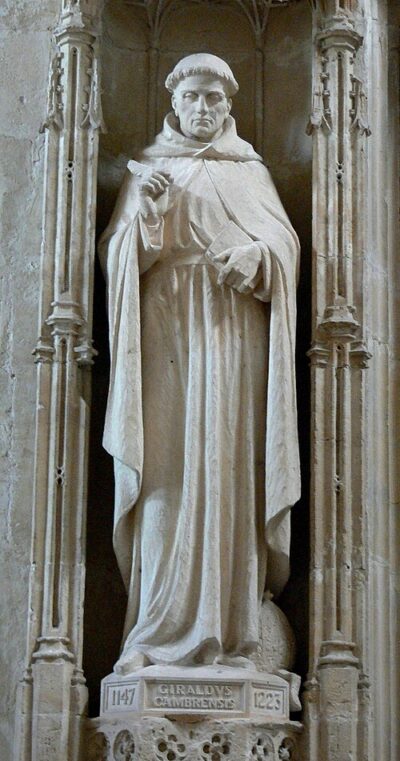
Itinerarium Cambriae
Itinerarium Cambriae is a medieval account of a journey made by Gerald of Wales.
- Written by
- Gerald of Wales
- Genre
- travel literature
All 4 facts, and where they come from
Facts
4 facts · 0 confirmed by two sources · 0 cited · 4 from one source
Where this comes from
Papalocal keeps its own record. It started from these sources; what each one said is kept here as it was copied, so a change on their side never changes this page by itself. Tap one to read its version.
What Wikidata says · copied November 17, 2026 · revision 2283193162
- Described as
- medieval account of a journey made by Gerald of Wales
- What it is
- literary work
- Written by
- Gerald of Wales
- Genre
- travel literature
- Language
- medieval Latin
- Wikipedias with a page
- 2
Wikidata item Q13128947 (wikidata.org/wiki/Q13128947), public domain (CC0). Copied 2026-11-17.
What Wikipedia says · copied November 17, 2026 · revision 1384743708
The Itinerarium Cambriae ("The Itinerary Through Wales") is a medieval account of a journey made by Gerald of Wales, written in Latin.
Gerald was selected to accompany the Archbishop of Canterbury, Baldwin of Forde, on a tour of Wales in 1188, the object being a recruitment campaign for the Third Crusade. His account of that journey, the Itinerarium Cambriae (1191) (later followed by the Descriptio Cambriae in 1194) remains a very valuable historical document, significant for the descriptions – however untrustworthy and inflected by ideology, whimsy, and his unique style – of Welsh and Norman culture.
Gerald's biases, according to W. Llewelyn Williams, were well balanced. He writes that in the Itinerarium, and its companion Descriptio, Gerald was "impartial in his evidence, and judicial in his decisions. If he errs at all, it is not through racial prejudice. 'I am sprung,' he once told the Pope in a letter, 'from the princes of Wales and from the barons of the Marches, and when I see injustice in either race, I hate it.'"
Manuscript copies of the text are held by the British Library, Bodleian Library, and the University Library, Cambridge. The British Library manuscript has some large coloured foliate initials.
The work plays a role in the plot of Thomas Love Peacock's 1831 novel Crotchet Castle, where the medieval enthusiast Mr. Chainmail proposes to retrace the steps of "Giraldus de Barri".
From the Wikipedia article “Itinerarium Cambriae” (en.wikipedia.org/wiki/Itinerarium_Cambriae), by its contributors, under CC BY-SA 4.0 (creativecommons.org/licenses/by-sa/4.0/). Copied 2026-11-17; not changed.
Confirmed Two sources agree. Cited One source, and it names where it got it. One source One source, without a reference of its own. Sources disagree The sources disagree. We show the best-supported value and keep theirs below.