
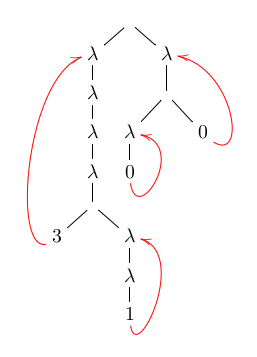
lambda calculus
Lambda calculus is a formal system in mathematical logic.
All 2 facts, and where they come from
Facts
2 facts · 0 confirmed by two sources · 0 cited · 2 from one source
Where this comes from
Papalocal keeps its own record. It started from these sources; what each one said is kept here as it was copied, so a change on their side never changes this page by itself. Tap one to read its version.
What Wikidata says · copied November 16, 2026 · revision 2520617444
- Described as
- formal system in mathematical logic
- Other names
- λ-calculus, lambda calculi, λ-calculi, untyped lambda calculus, type-free lambda calculus
- What it is
- mathematical model
- Named after
- Λ
- Wikipedias with a page
- 47
Wikidata item Q242028 (wikidata.org/wiki/Q242028), public domain (CC0). Copied 2026-11-16.
What Wikipedia says · copied November 16, 2026 · revision 1385743479
In mathematical logic, the lambda calculus (also written as λ-calculus) is a formal system for expressing computation based on function abstraction and application using variable binding and substitution. Untyped lambda calculus, the topic of this article, is a universal machine, i.e. a model of computation that can be used to simulate any Turing machine (and vice versa). It was introduced by the mathematician Alonzo Church in the 1930s as part of his research into the foundations of mathematics. In 1936, Church found a formulation which was logically consistent, and documented it in 1940.
From the Wikipedia article “Lambda calculus” (en.wikipedia.org/wiki/Lambda_calculus), by its contributors, under CC BY-SA 4.0 (creativecommons.org/licenses/by-sa/4.0/). Copied 2026-11-16; not changed.
Confirmed Two sources agree. Cited One source, and it names where it got it. One source One source, without a reference of its own. Sources disagree The sources disagree. We show the best-supported value and keep theirs below.
Picture: PIerre.Lescanne, via Wikimedia Commons · CC BY-SA 4.0
