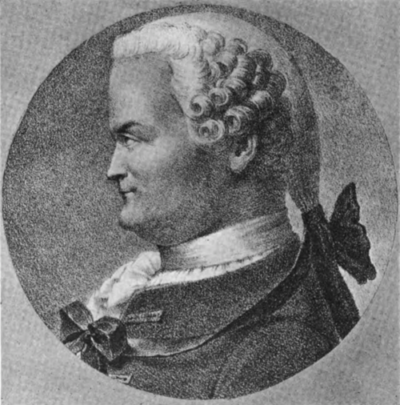
Lambert W function
Lambert W function is a multivalued function that is the inverse of the map z ↦ z exp(z).
All 2 facts, and where they come from
Facts
2 facts · 0 confirmed by two sources · 0 cited · 2 from one source
Where this comes from
Papalocal keeps its own record. It started from these sources; what each one said is kept here as it was copied, so a change on their side never changes this page by itself. Tap one to read its version.
What Wikidata says · copied November 17, 2026 · revision 2540907960
- Described as
- multivalued function that is the inverse of the map z ↦ z exp(z)
- Other names
- product logarithm, omega function
- What it is
- function
- Named after
- Johann Heinrich Lambert
- Wikipedias with a page
- 27
Wikidata item Q429331 (wikidata.org/wiki/Q429331), public domain (CC0). Copied 2026-11-17.
What Wikipedia says · copied November 17, 2026 · revision 1384648384
In mathematics, the Lambert W function, also called the omega function or product logarithm, is a multivalued function, namely the branches of the converse relation of the function f(w)=wew, where w is any complex number and ew is the exponential function. The function is named after Johann Lambert, who considered a related problem in 1758. Building on Lambert's work, Leonhard Euler described the W function per se in 1783.
For each integer k there is one branch, denoted by Wk(z), which is a complex-valued function of one complex argument. W0 is known as the principal branch. These functions have the following property: if z and w are any complex numbers, thenwew=z
holds if and only ifw=Wk(z) for some integer k.
When dealing with real numbers only, the two branches W0 and W−1 suffice: for real numbers x and y the equationyey=x
can be solved for y only if x≥−1e; yields y=W0(x) if x≥0 and the two values y=W0(x) and y=W−1(x) if −1e≤x<0.
The Lambert W function's branches cannot be expressed in terms of elementary functions. It is useful in combinatorics, for instance, in the enumeration of trees. It can be used to solve various equations involving exponentials (e.g. the maxima of the Planck, Bose–Einstein, and Fermi–Dirac distributions) and also occurs in the solution of delay differential equations, such as y′(t)=a y(t−1). In biochemistry, and in particular enzyme kinetics, an opened-form solution for the time-course kinetics analysis of Michaelis–Menten kinetics is described in terms of the Lambert W function.
From the Wikipedia article “Lambert W function” (en.wikipedia.org/wiki/Lambert_W_function), by its contributors, under CC BY-SA 4.0 (creativecommons.org/licenses/by-sa/4.0/). Copied 2026-11-17; not changed.
Confirmed Two sources agree. Cited One source, and it names where it got it. One source One source, without a reference of its own. Sources disagree The sources disagree. We show the best-supported value and keep theirs below.
Picture: Wikimedia Commons: Lambert-w.svg · See Commons file page