
Lao People's Revolutionary Party
The Lao People's Revolutionary Party is a political party in Laos. It was founded in 1955. Its headquarters are in Vientiane. It stands for left-wing nationalism, Marxism–Leninism and Kaysone Phomvihane Thought.
- Country
- Laos
- Founded
- March 22, 1955
- Ideology
- left-wing nationalism
All 10 facts, and where they come from
Facts
10 facts · 0 confirmed by two sources · 0 cited · 10 from one source
Where this comes from
Papalocal keeps its own record. It started from these sources; what each one said is kept here as it was copied, so a change on their side never changes this page by itself. Tap one to read its version.
What Wikidata says · copied November 17, 2026 · revision 2549388361
- Described as
- political party in Laos
- What it is
- political party
- Founded
- March 22, 1955
- Headquarters
- Vientiane
- Country
- Laos · 1 reference
- Chair
- Choummaly Sayasone (2006–); Bounnhang Vorachit
- Ideology
- left-wing nationalism; Marxism–Leninism; Kaysone Phomvihane Thought
- Official website
- https://ccop.gov.la/
- Wikipedias with a page
- 38
Wikidata item Q756180 (wikidata.org/wiki/Q756180), public domain (CC0). Copied 2026-11-17.
What Wikipedia says · copied November 17, 2026 · revision 1380724494
The Lao People's Revolutionary Party (LPRP) is the founding and sole ruling party of the Lao People's Democratic Republic. The party's monopoly on state power is guaranteed by Article 3 of the Constitution of Laos, and it maintains a unitary state with centralised control over the economy and military.
The LPRP was established on 22 March 1955 by former members of the Indochinese Communist Party. It led the insurgency against the Royal Lao Government and supported North Vietnamese forces in the Vietnam War. The insurgency culminated with the LPRP securing power in Laos in 1975. During its first years in power, the party strengthened party-state control over society and attempted to establish a planned economy based on the Soviet model. In the 1980s, influenced by market reforms in China and Vietnam, the LPRP initiated economic reforms that privatised state companies and legalised private property.
Democratic centralism, a concept conceived by Russian Marxist Vladimir Lenin, is the organisational form of the LPRP. The highest institution of the party is the National Congress, which elects the Central Committee. In between party congresses, the Central Committee is the highest decision-making organ regarding party affairs. After a party congress, the Central Committee elects the Politburo and Secretariat, as well as the General Secretary, the highest party officer. In between sessions of the Central Committee, the Politburo is the highest decision-making body. As of 2026, the 12th Politburo comprises 13 members. The current party leader is Thongloun Sisoulith, who holds the titles of General Secretary of the Central Committee, Chairman of the Defence and Public Security Commission, and Prime Minister of Laos, who is the head of government.
The LPRP is committed to communism and participates in the International Meeting of Communist and Workers' Parties, an annual international forum of communist parties. According to the party statute, the party adheres to Marxism–Leninism and Kaysone Phomvihane Thought. Upon taking power in 1975, the party sought to immediately abolish the capitalist mode of production through a people's democratic revolution and establishing a people's democratic state, which would pave the way to a socialist society. By the 1990s, the direction of the party had changed, and the party leadership believed that Laos was too underdeveloped to immediately initiate the construction of socialism. The party thus adopted a policy in which the people's democratic state used state capitalism as a tool to construct the material base of socialism.
From the Wikipedia article “Lao People's Revolutionary Party” (en.wikipedia.org/wiki/Lao_People's_Revolutionary_Party), by its contributors, under CC BY-SA 4.0 (creativecommons.org/licenses/by-sa/4.0/). Copied 2026-11-17; not changed.
Confirmed Two sources agree. Cited One source, and it names where it got it. One source One source, without a reference of its own. Sources disagree The sources disagree. We show the best-supported value and keep theirs below.
People connected 9
Party members
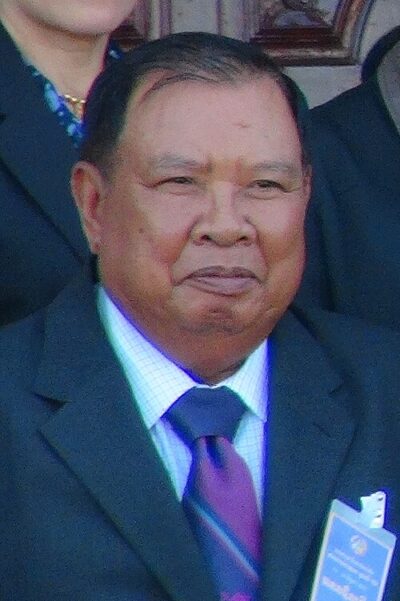 Bounnhang VorachitGeneral Secretary of the Lao People's Revolutionary Party (2016-2021)
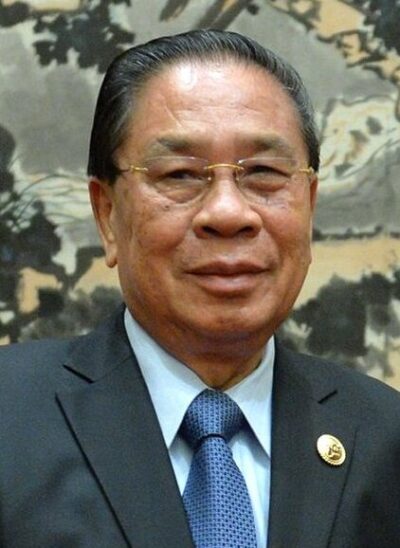 Choummaly Sayasoneformer General Secretary of the Lao People's Revolutionary Party
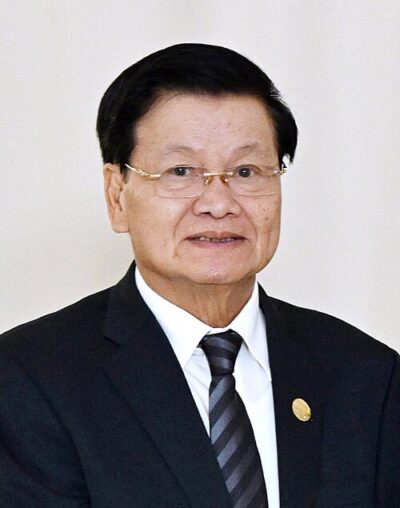 Thongloun SisoulithGeneral Secretary of the Lao People's Revolutionary Party
 SouphanouvongLaotian politician
 Kaysone Phomvihanefirst General Secretary of the Lao People's Revolutionary Party (r. 1955-1992)
 Khamtai Siphandone (1955–2006)former Chairman of the Lao People's Revolutionary Party (1924–2025)
 Thongsing ThammavongPrime Minister of Laos
 Bouasone BouphavanhLaotian politician
 Phankham ViphavanhLaotian politician
