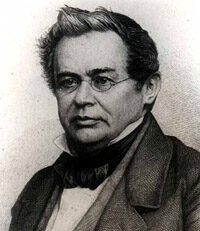
Lenz's law
Lenz's law is an electromagnetic phenomena where changing magnetic fields induce currents with opposing fields.
All 2 facts, and where they come from
Facts
2 facts · 0 confirmed by two sources · 0 cited · 2 from one source
Where this comes from
Papalocal keeps its own record. It started from these sources; what each one said is kept here as it was copied, so a change on their side never changes this page by itself. Tap one to read its version.
What Wikidata says · copied November 17, 2026 · revision 2538482059
- Described as
- electromagnetic phenomena where changing magnetic fields induce currents with opposing fields
- What it is
- physical law
- Named after
- Emil Lenz
- Wikipedias with a page
- 58
Wikidata item Q192288 (wikidata.org/wiki/Q192288), public domain (CC0). Copied 2026-11-17.
What Wikipedia says · copied November 17, 2026 · revision 1380174728
Lenz's law states that the direction of the electric current induced in a conductor by a changing magnetic field is such that the magnetic field created by the induced current opposes changes in the initial magnetic field. It is named after physicist Heinrich Lenz, who formulated it in 1834.
The Induced current is the current generated in a wire due to change in magnetic flux.
It is a qualitative law that specifies the direction of induced current, but states nothing about its magnitude. Lenz's law predicts the direction of many effects in electromagnetism, such as the direction of voltage induced in an inductor or wire loop by a changing current, or the drag force of eddy currents exerted on moving objects in the magnetic field.
Lenz's law may be seen as analogous to Newton's third law in classical mechanics and Le Chatelier's principle in chemistry.
From the Wikipedia article “Lenz's law” (en.wikipedia.org/wiki/Lenz's_law), by its contributors, under CC BY-SA 4.0 (creativecommons.org/licenses/by-sa/4.0/). Copied 2026-11-17; not changed.
Confirmed Two sources agree. Cited One source, and it names where it got it. One source One source, without a reference of its own. Sources disagree The sources disagree. We show the best-supported value and keep theirs below.
Picture: Wikimedia Commons: Lenz law demonstration.png · See Commons file page