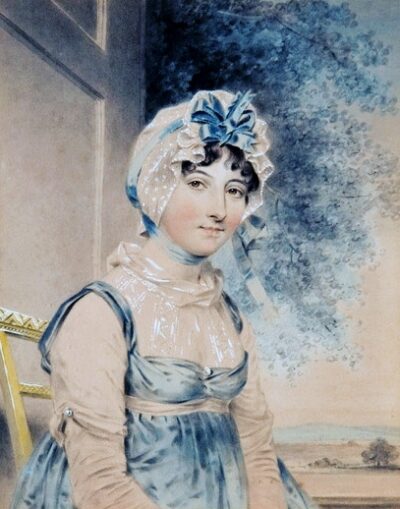
Leonora
Leonora is a creative work by Maria Edgeworth (London : Joyce Gold, printer, Shoe Lane. Printed for J. Johnson, 1806.).
- Published
- 1806
- Written by
- Maria Edgeworth
- Genre
- epistolary novel
All 6 facts, and where they come from
Facts
6 facts · 0 confirmed by two sources · 3 cited · 3 from one source
Where this comes from
Papalocal keeps its own record. It started from these sources; what each one said is kept here as it was copied, so a change on their side never changes this page by itself. Tap one to read its version.
What Wikidata says · copied November 17, 2026 · revision 2568922886
- Described as
- creative work by Maria Edgeworth (London : Joyce Gold, printer, Shoe Lane. Printed for J. Johnson, 1806.)
- What it is
- literary work · 1 reference
- Written by
- Maria Edgeworth · 1 reference
- Publisher
- Joseph Johnson
- Genre
- epistolary novel
- Published
- 1806 · 1 reference
- Language
- English
- Wikipedias with a page
- 2
Wikidata item Q6526682 (wikidata.org/wiki/Q6526682), public domain (CC0). Copied 2026-11-17.
What Wikipedia says · copied November 17, 2026 · revision 1384269397
Leonora is a novel written by Maria Edgeworth and published in 1806.
Although Edgeworth is known for having her novels (Castle Rackrent, The Absentee) address issues of nationalism in an Anglo-Irish context, Leonora instead privileges English manners over French ones. The plot of the novel centres on the newly married Leonora and her decision to bring back to England a woman who had been exiled to France. The woman, Olivia, is known as a "coquette," and her controversial behaviour with regard to her marriage had driven her to France, where she cultivated an aristocratic, "French" sensibility that exists apart from conventional morality.
The novel is written in an epistolary style, which means all of the action is mediated through personal letters and the letter-writers' points-of-view. By having the main characters tell the story through their own perspectives, the reader gets to read full articulations of competing sensibilities and philosophies, although the narrative clearly prefers Leonora's prudent reserve over Olivia's extravagant emotional displays.
Indeed, this novel can be read as a critique of sensibility, a behavioural phenomenon that tries to correlate a person's emotional sensitivity with her elevated moral sentiments. Olivia, a self-professed woman of sensibility, often makes dramatic displays of feeling that are described by others as "theatrical," or contrived, and in her personal correspondence with her French friend, Gabrielle, Olivia makes grand claims about sentiment and love that, conveniently, justify her insatiable need for attention, particularly male attention. While a conventional reading of Jane Austen's Sense and Sensibility dismisses the heroine Marianne's sensibility as romantic teenage folly, Edgeworth's novel Leonora emphasises Olivia's behaviour as hypocritical narcissism.
Maria Edgeworth's letter to Mrs. Pruxton at Black Castle, Navan, dated 8 June 1806, reads:
"------ Lady Olivia in 'Leonora' is now supposed by all Dublin to be a portrait of Lady Asgill [wife of Sir Charles Asgill, 2nd Baronet] and that wherever they go they have to defend me by asserting that I'm not acquainted with the said Lady Asgill. Very luckily I never did meet her at Lady Holt's where she was intimate. She was educated by Mademoiselle Le Noir who was Miss Bracebridge's governess and who was more like Mademoiselle Panache than Lady Asgill is - to Olivia - at all events this fancy of the Dublin fine world promotes the sale of the book and I am content. -------."
Lady Bessborough, writing to Granville Leveson-Gower from Paris on Thursday, 23 December 1802, had this to say about Maria Edgeworth:
"…..I was introduc'd by him [François de la Harpe] to the famous Miss Edgeworth and her Brother. By the by, I am sure she wrote it all herself, for the brother seems a fool and a coxcomb; she very ugly, but delightful."
From the Wikipedia article “Leonora (novel)” (en.wikipedia.org/wiki/Leonora_(novel)), by its contributors, under CC BY-SA 4.0 (creativecommons.org/licenses/by-sa/4.0/). Copied 2026-11-17; not changed.
Confirmed Two sources agree. Cited One source, and it names where it got it. One source One source, without a reference of its own. Sources disagree The sources disagree. We show the best-supported value and keep theirs below.
Picture: Wikimedia Commons: Leonora 1806.jpg · See Commons file page