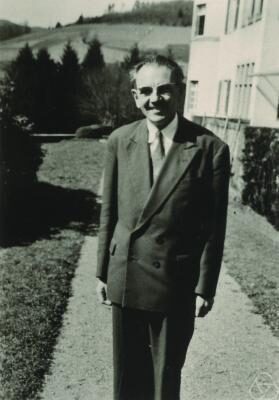
Leray's theorem
Leray's theorem is a theorem that, for a sheaf that is acyclic on every finite intersection of an open cover, the sheaf cohomology coincides with Čech cohomology.
All 2 facts, and where they come from
Facts
2 facts · 0 confirmed by two sources · 0 cited · 2 from one source
Where this comes from
Papalocal keeps its own record. It started from these sources; what each one said is kept here as it was copied, so a change on their side never changes this page by itself. Tap one to read its version.
What Wikidata says · copied November 18, 2026 · revision 2398128565
- Described as
- theorem that, for a sheaf that is acyclic on every finite intersection of an open cover, the sheaf cohomology coincides with Čech cohomology
- What it is
- theorem
- Named after
- Jean Leray
- Wikipedias with a page
- 2
Wikidata item Q6528747 (wikidata.org/wiki/Q6528747), public domain (CC0). Copied 2026-11-18.
What Wikipedia says · copied November 18, 2026 · revision 1375553776
In algebraic topology and algebraic geometry, Leray's theorem (so named after Jean Leray) relates abstract sheaf cohomology with Čech cohomology.
Let ℱ be a sheaf on a topological space X and 𝒰={Ui}i∈I an open cover of X. If ℱ is acyclic on every finite intersection of elements of 𝒰 (meaning that Hk(Ui0∩⋯∩Uin,ℱ)=0 for all k≥1 and all finite intersections Ui0∩⋯∩Uin), then there is an isomorphism
Hˇq(𝒰,ℱ)≅Hq(X,ℱ)
for all q≥0, where Hˇq(𝒰,ℱ) is the q-th Čech cohomology group of ℱ with respect to the open cover 𝒰, and Hq(X,ℱ) is the abstract sheaf cohomology group.
From the Wikipedia article “Leray's theorem” (en.wikipedia.org/wiki/Leray's_theorem), by its contributors, under CC BY-SA 4.0 (creativecommons.org/licenses/by-sa/4.0/). Copied 2026-11-18; not changed.
Confirmed Two sources agree. Cited One source, and it names where it got it. One source One source, without a reference of its own. Sources disagree The sources disagree. We show the best-supported value and keep theirs below.