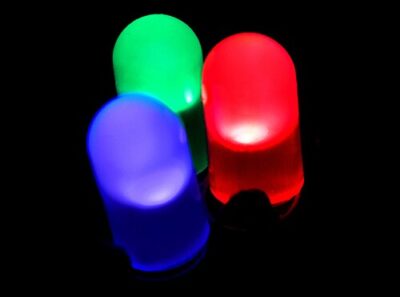
light-emitting diode
light-emitting diode is a solid-state semiconductor light source.
All 2 facts, and where they come from
Facts
2 facts · 0 confirmed by two sources · 0 cited · 2 from one source
Where this comes from
Papalocal keeps its own record. It started from these sources; what each one said is kept here as it was copied, so a change on their side never changes this page by itself. Tap one to read its version.
What Wikidata says · copied November 17, 2026 · revision 2531278433
- Described as
- solid-state semiconductor light source
- Other names
- LED
- What it is
- type of electronic component; active electronic component
- Wikipedias with a page
- 85
Wikidata item Q25504 (wikidata.org/wiki/Q25504), public domain (CC0). Copied 2026-11-17.
What Wikipedia says · copied November 17, 2026 · revision 1385505056
A light-emitting diode (LED) is an electronic component that uses a semiconductor to emit light when current flows through it. Electrons in the semiconductor recombine with electron holes, thereby releasing energy in the form of photons. The color of the light (corresponding to the energy of the photons) is determined by the energy required for electrons to cross the band gap of the semiconductor. White light is obtained by using multiple semiconductors or a layer of light-emitting phosphor on the semiconductor device.
Appearing as practical electronic components in 1962, the earliest LEDs emitted low-intensity infrared (IR) light. Infrared LEDs are used in remote-control circuits, such as those used with a wide variety of consumer electronics. The first visible-light LEDs were of low intensity and limited to red.
Early LEDs were often used as indicator lamps, replacing small incandescent bulbs, and in seven-segment displays. Later developments produced LEDs available in visible, ultraviolet (UV), and infrared wavelengths with high, low, or intermediate light output, such as white LEDs suitable for room and outdoor lighting. LEDs have also given rise to new types of displays and sensors, while their high switching rates have uses in advanced communications technology. LEDs have been used in diverse applications such as aviation lighting, fairy lights, strip lights, automotive headlamps, advertising, stage lighting, general lighting, traffic signals, camera flashes, lighted wallpaper, horticultural grow lights, and medical devices.
LEDs have many advantages over incandescent light sources, including lower power consumption, reduced waste heat, a longer lifetime, improved physical robustness, smaller sizes, and faster switching. In exchange for these generally favorable attributes, disadvantages of LEDs include electrical limitations to low voltage and generally to DC (not AC) power, the inability to provide steady illumination from a pulsing DC or an AC electrical supply source, and a lower maximum operating and storage temperatures.
LEDs are transducers of electricity into light.
From the Wikipedia article “Light-emitting diode” (en.wikipedia.org/wiki/Light-emitting_diode), by its contributors, under CC BY-SA 4.0 (creativecommons.org/licenses/by-sa/4.0/). Copied 2026-11-17; not changed.
Confirmed Two sources agree. Cited One source, and it names where it got it. One source One source, without a reference of its own. Sources disagree The sources disagree. We show the best-supported value and keep theirs below.
Picture: PiccoloNamek, via Wikimedia Commons · CC BY-SA 3.0