Madonna with Canon Joris van der Paele
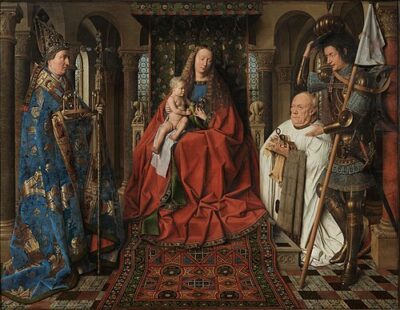
Madonna with Canon Joris van der Paele is a painting by Jan van Eyck, Groeningemuseum. It came out in 1436. It is based on Saint George and the Dragon.
- Came out
- 1436
- Created by
- Jan van Eyck
- Genre
- religious art
All 6 facts, and where they come from
Facts
6 facts · 0 confirmed by two sources · 3 cited · 3 from one source
Where this comes from
Papalocal keeps its own record. It started from these sources; what each one said is kept here as it was copied, so a change on their side never changes this page by itself. Tap one to read its version.
What Wikidata says · copied November 17, 2026 · revision 2533922467
- Described as
- painting by Jan van Eyck, Groeningemuseum
- Other names
- Virgin and Child with Canon van der Paele, The Virgin and Child with Canon Joris Van der Paele
- What it is
- painting · 1 reference
- Created by
- Jan van Eyck · 1 reference
- Genre
- religious art
- Based on
- Saint George and the Dragon
- Came out
- 1436 · 1 reference
- Country
- Belgium
- Wikipedias with a page
- 22
Wikidata item Q2480921 (wikidata.org/wiki/Q2480921), public domain (CC0). Copied 2026-11-17.
What Wikipedia says · copied November 17, 2026 · revision 1349111705
The Virgin and Child with Canon van der Paele is a large oil-on-oak panel painting completed around 1434–1436 by the Early Netherlandish painter Jan van Eyck. It shows the painting's donor, Joris van der Paele, within an apparition of saints. The Virgin Mary is enthroned at the centre of the semicircular space, which most likely represents a church interior, with the Christ Child on her lap. St. Donatian stands to her right, Saint George—the donor's name saint—to her left. The panel was commissioned by van der Paele as an altarpiece. He was then a wealthy clergyman from Bruges, but elderly and gravely ill, and intended the work as his memorial.
The saints are identifiable from Latin inscriptions lining the borders of the imitation bronze frame, which is original. Van der Paele is identifiable from historical records. He is dressed in the finery of a medieval canon, including white surplice, as he piously reads from a book of hours. He is presented to Mary by Saint George, his name saint, who holds aloft his metal helmet in respect. Saint Donatian, dressed in brightly coloured vestments, stands to the left. The panel is noted for the finery of clothing, including exquisite representations of furs, silks and brocades, and the elaborate and detailed religious iconography. The Virgin's throne is decorated with carved representations of Adam and Eve, Cain and Abel, prefigurations of the Crucifixion and Resurrection of Jesus, and scenes from the Old Testament. The painting is lined with a series of inscriptions which comment on the saints, and include van Eyck's signature.
The van der Paele panel is widely considered one of van Eyck's most fully realised and ambitious works, and has been described as a "masterpiece of masterpieces".
From the Wikipedia article “Virgin and Child with Canon van der Paele” (en.wikipedia.org/wiki/Virgin_and_Child_with_Canon_van_der_Paele), by its contributors, under CC BY-SA 4.0 (creativecommons.org/licenses/by-sa/4.0/). Copied 2026-11-17; not changed.
Confirmed Two sources agree. Cited One source, and it names where it got it. One source One source, without a reference of its own. Sources disagree The sources disagree. We show the best-supported value and keep theirs below.
Picture: Jan van Eyck, via Wikimedia Commons · Public domain