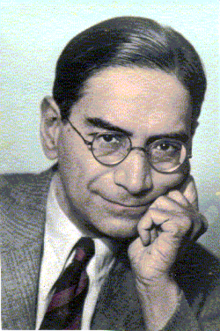
Mahalanobis model
Mahalanobis model is a Marxist model of economic development.
All 2 facts, and where they come from
Facts
2 facts · 0 confirmed by two sources · 0 cited · 2 from one source
Where this comes from
Papalocal keeps its own record. It started from these sources; what each one said is kept here as it was copied, so a change on their side never changes this page by itself. Tap one to read its version.
What Wikidata says · copied November 17, 2026 · revision 2474287309
- Described as
- Marxist model of economic development
- Other names
- Feldman–Mahalanobis model
- What it is
- economic model
- Named after
- Prasanta Chandra Mahalanobis
- Wikipedias with a page
- 5
Wikidata item Q720623 (wikidata.org/wiki/Q720623), public domain (CC0). Copied 2026-11-17.
What Wikipedia says · copied November 17, 2026 · revision 1335407726
The Feldman–Mahalanobis model is a Marxist model of economic development, created independently by Soviet economist Grigory Feldman in 1928 and Indian statistician Prasanta Chandra Mahalanobis in 1953. Mahalanobis became essentially the key economist of India's Second Five Year Plan, becoming subject to much of India's most dramatic economic debates.
The essence of the model is a shift in the pattern of industrial investment towards building up a domestic consumption goods sector. Thus the strategy suggests in order to reach a high standard in consumption, investment in building a capacity in the production of capital goods is firstly needed. A high enough capacity in the capital goods sector expands in the long-run the nation's consumer-goods production capacity.
This distinction between the two different types of goods was a clearer formulation of Marx's ideas in Das Kapital, and also helped people to better understand the extent of the trade off between the levels of immediate and future consumption. These ideas were first introduced in 1928 by Feldman, then an economist working for the GOSPLAN planning commission, where he presented theoretical arguments of a two-department scheme of growth. There is no evidence that Mahalanobis knew of Feldman's approach, being kept behind the borders of the USSR.
From the Wikipedia article “Feldman–Mahalanobis model” (en.wikipedia.org/wiki/Feldman–Mahalanobis_model), by its contributors, under CC BY-SA 4.0 (creativecommons.org/licenses/by-sa/4.0/). Copied 2026-11-17; not changed.
Confirmed Two sources agree. Cited One source, and it names where it got it. One source One source, without a reference of its own. Sources disagree The sources disagree. We show the best-supported value and keep theirs below.