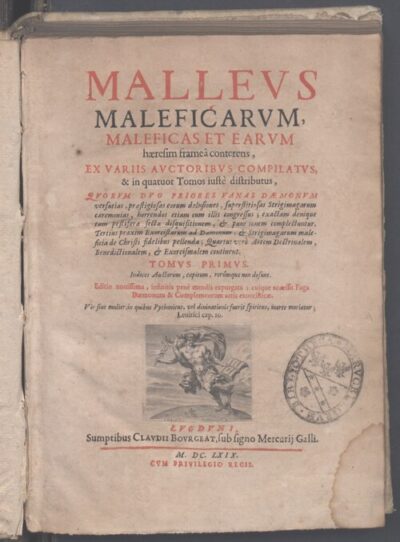
Malleus maleficarum
Malleus maleficarum is a treatise on the prosecution of witches. It came out in 1487. It was written by Heinrich Kramer and Jacob Sprenger.
- Released
- 1487
- Written by
- Heinrich Kramer
- Genre
- theology
All 7 facts, and where they come from
Facts
7 facts · 0 confirmed by two sources · 0 cited · 7 from one source
Where this comes from
Papalocal keeps its own record. It started from these sources; what each one said is kept here as it was copied, so a change on their side never changes this page by itself. Tap one to read its version.
What Wikidata says · copied November 18, 2026 · revision 2536876981
- Described as
- treatise on the prosecution of witches
- Other names
- Hammer of Witches
- What it is
- reference work
- Written by
- Heinrich Kramer; Jacob Sprenger
- Genre
- theology; treatise
- Released
- 1487
- Language
- medieval Latin
- Wikipedias with a page
- 53
Wikidata item Q208556 (wikidata.org/wiki/Q208556), public domain (CC0). Copied 2026-11-18.
What Wikipedia says · copied November 18, 2026 · revision 1381374559
The Malleus Maleficarum, usually translated as the Hammer of Witches, is the best known treatise about witchcraft. It was written by German Catholic clergyman Heinrich Kramer (under his Latinized name Henricus Institor) and first published in the German city of Speyer in 1486. Some characterize the book as a compendium of preexisting demonological literature of the 15th century, as opposed to an original work.
In 1484, two years before the work’s publication, Pope Innocent VIII authorised Kramer to investigate alleged witchcraft in the papal bull Summis desiderantes affectibus. Kramer presented his text as an official position of the Catholic Church. The book was condemned by top theologians of the Inquisition at the Faculty of Cologne for recommending illegal procedures and for inconsistencies with existing Catholic demonological doctrines. Kramer was not disciplined by the Church and even enjoyed considerable prestige thereafter.
The Malleus classifies sorcery as heresy, a severe crime at the time, and recommends that secular courts prosecute it accordingly. The Malleus suggests torture to get confessions and death as the only certain way to end the "evils of witchcraft". When it was published, heretics were often sentenced to be burned alive at the stake, and the Malleus suggested the same for "witches". Despite its condemnation by some members of the church, the Malleus was very popular.
Jacob Sprenger was credited as a coauthor from 1519 onward, although his role in the text and authorial relationship with Kramer is subject to debate.
The book was later revived by royal courts during the Renaissance, which contributed to the increasingly brutal prosecution of witchcraft during the 16th and 17th centuries.
From the Wikipedia article “Malleus Maleficarum” (en.wikipedia.org/wiki/Malleus_Maleficarum), by its contributors, under CC BY-SA 4.0 (creativecommons.org/licenses/by-sa/4.0/). Copied 2026-11-18; not changed.
Confirmed Two sources agree. Cited One source, and it names where it got it. One source One source, without a reference of its own. Sources disagree The sources disagree. We show the best-supported value and keep theirs below.
Picture: Wikimedia Commons: Sprenger - Malleus maleficarum, 1669 - BEIC 9477645.tiff · See Commons file page