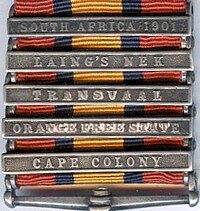
medal bar
Medal bar is a thin metal bar attached to the ribbon of a medal as an additional award.
All 1 facts, and where they come from
Facts
1 facts · 0 confirmed by two sources · 0 cited · 1 from one source
Where this comes from
Papalocal keeps its own record. It started from these sources; what each one said is kept here as it was copied, so a change on their side never changes this page by itself. Tap one to read its version.
What Wikidata says · copied November 17, 2026 · revision 2541128808
- Described as
- thin metal bar attached to the ribbon of a medal as an additional award
- Other names
- medal clasp, bar, clasp
- What it is
- grade of an order
- Wikipedias with a page
- 11
Wikidata item Q3537204 (wikidata.org/wiki/Q3537204), public domain (CC0). Copied 2026-11-17.
What Wikipedia says · copied November 17, 2026 · revision 1351157259
A medal bar or medal clasp is a thin metal bar attached to the ribbon of a military decoration, civil decoration, or other medal. It most commonly indicates the campaign or operation the recipient received the award for, and multiple bars on the same medal are used to indicate that the recipient has met the criteria for receiving the medal in multiple theatres.
When used in conjunction with decorations for exceptional service, such as gallantry medals, the term "and bar" means that the award has been bestowed multiple times. In the example, "Group Captain Leonard Cheshire, VC, OM, DSO and two bars, DFC", "DSO and two bars" means that the Distinguished Service Order was awarded on three occasions. A British convention is to indicate bars by the use of asterisks; thus, DSO** would denote a DSO and two bars.
Bars are also used on long-service medals to indicate the length of service rendered.
The two terms are used because "bar" and "clasp" refer to two parts of the medal: the indicator discussed in this article, and the part of the medal connected to the ribbon.
From the Wikipedia article “Medal bar” (en.wikipedia.org/wiki/Medal_bar), by its contributors, under CC BY-SA 4.0 (creativecommons.org/licenses/by-sa/4.0/). Copied 2026-11-17; not changed.
Confirmed Two sources agree. Cited One source, and it names where it got it. One source One source, without a reference of its own. Sources disagree The sources disagree. We show the best-supported value and keep theirs below.
Picture: Jim Linwood, via Wikimedia Commons · CC BY 2.0