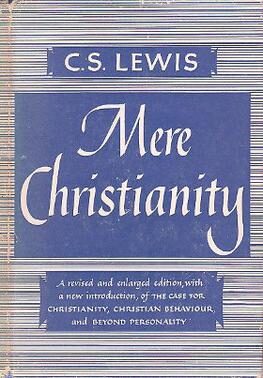
Mere Christianity
Mere Christianity is a book by C. S. Lewis on the fundamentals of Christianity. It came out in 1952.
- Published
- 1952
- Written by
- C. S. Lewis
- Country of origin
- United Kingdom
All 8 facts, and where they come from
Facts
8 facts · 0 confirmed by two sources · 0 cited · 8 from one source
Where this comes from
Papalocal keeps its own record. It started from these sources; what each one said is kept here as it was copied, so a change on their side never changes this page by itself. Tap one to read its version.
What Wikidata says · copied November 17, 2026 · revision 2555914755
- Described as
- book by C. S. Lewis on the fundamentals of Christianity
- What it is
- written work; apologia
- Written by
- C. S. Lewis
- Publisher
- Macmillan Publishers
- Published
- 1952
- Language
- English
- Country of origin
- United Kingdom
- Comes after
- The Abolition of Man
- Wikipedias with a page
- 17
Wikidata item Q1078487 (wikidata.org/wiki/Q1078487), public domain (CC0). Copied 2026-11-17.
What Wikipedia says · copied November 17, 2026 · revision 1384220880
Mere Christianity is a Christian apologetics book by the British author C. S. Lewis. It was adapted from a series of BBC radio talks made between 1941 and 1944, originally published as three separate volumes: Broadcast Talks (1942), Christian Behaviour (1943), and Beyond Personality (1944). The book consists of four parts: the first presents Lewis's arguments for the existence of God; the second contains his defence of Christian theology, including his notable "Liar, lunatic, or Lord" trilemma; the third has him exploring Christian ethics, among which are cardinal and theological virtues; in the final, he writes on the Christian conception of God.
Mere Christianity was published in the United Kingdom by Geoffrey Bles on 7 July 1952. While initial reviews to the book were generally positive, modern reviewers were more critical of it, and its overall reception was relatively mixed. The praise was primarily directed to Lewis's humorous, straightforward style of writing; the criticism was primarily around the validity of his trilemma, which defends the Christian doctrine of the divinity of Jesus, and how he should have considered providing more choices.
Deemed a classic in Lewis's career and religious literature, Mere Christianity has often received a wide readership decades following its release, and contributed to establishing its author's reputation as "one of the most 'original' exponents of the Christian faith" in the 20th century. The work, with Lewis's arguments for God's existence in it, continued to be examined in scholarly circles. Mere Christianity has retained popularity among Christians from various denominations, and appeared in several lists of finest Christian books. Often used as a tool of evangelism, it has been translated into over thirty languages, and cited by a number of public figures as their influence to their conversion to Christianity. Several "biographies" of the book have also been written.
From the Wikipedia article “Mere Christianity” (en.wikipedia.org/wiki/Mere_Christianity), by its contributors, under CC BY-SA 4.0 (creativecommons.org/licenses/by-sa/4.0/). Copied 2026-11-17; not changed.
Confirmed Two sources agree. Cited One source, and it names where it got it. One source One source, without a reference of its own. Sources disagree The sources disagree. We show the best-supported value and keep theirs below.
Picture: Wikimedia Commons · Public domain