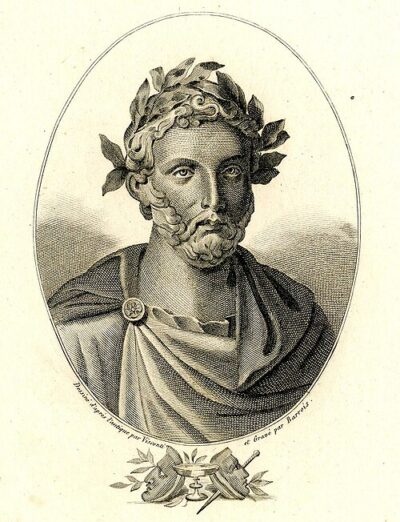
Miles gloriosus
Miles gloriosus is an ancient Roman play by Plautus.
- Written by
- Plautus
- Genre
- fabula palliata
All 4 facts, and where they come from
Facts
4 facts · 0 confirmed by two sources · 1 cited · 3 from one source
Where this comes from
Papalocal keeps its own record. It started from these sources; what each one said is kept here as it was copied, so a change on their side never changes this page by itself. Tap one to read its version.
What Wikidata says · copied November 17, 2026 · revision 2488981202
- Described as
- ancient Roman play by Plautus
- Other names
- Pl. Mil.
- What it is
- literary work
- Written by
- Plautus
- Genre
- fabula palliata
- Language
- Latin · 1 reference
- Wikipedias with a page
- 22
Wikidata item Q1230918 (wikidata.org/wiki/Q1230918), public domain (CC0). Copied 2026-11-17.
What Wikipedia says · copied November 17, 2026 · revision 1380722738
Miles Gloriosus is a comic play written by Titus Maccius Plautus (c. 254–184 BC). The title can be translated as "The Swaggering Soldier.” A now lost Greek play, Alazon, or The Braggart, served as a source. The comedy is set in Ephesus, a Greek city on the coast of Asia Minor.
The play is thought to date from early in Plautus's career, partly because it contains no polymetric cantica (songs that do not adhere to a single rhythm, which became frequent in the later plays), and partly because lines 210–211 have been taken as a reference to the temporary imprisonment of the poet Gnaeus Naevius in 206 BC.
At 1,437 lines, it is the longest of Plautus's surviving plays. Some scholars have suggested that it may combine two Greek originals; others have thought this unlikely. De Melo, however, suggests that Periplectomenus's long scene of self-praise (596–812) may come from another play; and the scene with Lurcio, which is not well integrated into the story, is also thought to be an addition invented by Plautus.
From the Wikipedia article “Miles Gloriosus (play)” (en.wikipedia.org/wiki/Miles_Gloriosus_(play)), by its contributors, under CC BY-SA 4.0 (creativecommons.org/licenses/by-sa/4.0/). Copied 2026-11-17; not changed.
Confirmed Two sources agree. Cited One source, and it names where it got it. One source One source, without a reference of its own. Sources disagree The sources disagree. We show the best-supported value and keep theirs below.