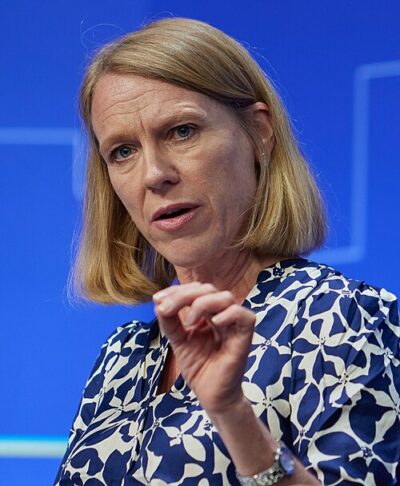
Minister of Children and Families
Minister of Children and Families is a Cabinet minister of Norway. It was created in 1955.
All 5 facts, and where they come from
Facts
5 facts · 0 confirmed by two sources · 0 cited · 5 from one source
Where this comes from
Papalocal keeps its own record. It started from these sources; what each one said is kept here as it was copied, so a change on their side never changes this page by itself. Tap one to read its version.
What Wikidata says · copied November 17, 2026 · revision 2524107118
- Described as
- Cabinet minister of Norway
- Other names
- Minister of Children, Equality and Social Inclusion, Minister of Children and Family Affairs
- What it is
- position
- Created
- August 1, 1955
- Country
- Norway
- Office of
- Norway
- Official website
- http://www.regjeringen.no/en/dep/bld.html?id=298 · 1 reference
- Wikipedias with a page
- 1
Wikidata item Q14436783 (wikidata.org/wiki/Q14436783), public domain (CC0). Copied 2026-11-17.
What Wikipedia says · copied November 17, 2026 · revision 1373780214
The Minister of Children and Families (Norwegian: Barne- og familieministeren, Northern Sami: mánáid- ja bearašministtar) is a Councilor of State and Chief of Norway's Ministry of Children and Family Affairs. Since 4 February 2025, Lene Vågslid has held the position. The ministry is responsible for policy and public operations related to children, youth and families as well as consumer rights. Major agencies subordinate to the ministry include the Consumer Council and the Directorate for Children, Youth and Family Affairs.
The position was created as the Minister of Families and Consumer Affairs on 1 August 1955 as part of Gerhardsen's Third Cabinet. The Labour Party's Aase Bjerkholt as the inaugural minister. While at first a consultative minister, she received her own ministry on 21 December 1956. Sixteen people from four parties have held the position. It has been a favored position of the Christian Democratic Party, who have held it in all center-right governments they have participated in except during the four weeks of Lyng's Cabinet, when it was held by Karen Grønn-Hagen of the Centre Party. The minister position was discontinued on 8 May 1972, when the portfolio was transferred to the Minister of Consumer Affairs and Government Administration. The position was recreated under the original name on 16 October 1989 and occupied by Solveig Sollie of the Christian Democratic Party. When her successor Matz Sandman of the Labour Party took over the following year, it was renamed the Minister of Children and Family Affairs. With the appointment of Karita Bekkemellem (Labour) in 2005, the position changed name the Minister of Children and Equality, receiving responsibility for the government's anti-discrimination policies. She would be the first of six ministers during Stoltenberg's Second Cabinet, with the three last representing the Socialist Left Party. With these the position changed to its current name, but lost its responsibilities for kindergartens.
The position has been dominated by females—the only males to hold the position were Matz Sandman (Labour, 1990–91), Audun Lysbakken (Socialist Left, 2009–12) and Kjell Ingolf Ropstad (Christian Democratic, 2019–21). Manuela Ramin-Osmundsen (Labour) became the first non-white minister of Norway when she was appointed in 2007. Both she and Lysbakken were forced to resign after issues related to cronyism. Two people have held the position twice: Bjerkholdt and Karita Bekkemellem. With a tenure of ten years, Bjerkholdt has held the position the longest.
From the Wikipedia article “Minister of Children and Families” (en.wikipedia.org/wiki/Minister_of_Children_and_Families), by its contributors, under CC BY-SA 4.0 (creativecommons.org/licenses/by-sa/4.0/). Copied 2026-11-17; not changed.
Confirmed Two sources agree. Cited One source, and it names where it got it. One source One source, without a reference of its own. Sources disagree The sources disagree. We show the best-supported value and keep theirs below.