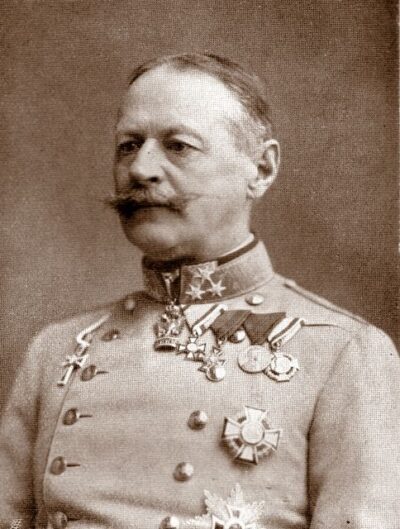
minister of war of Austria-Hungary
Minister of war of Austria-Hungary is a government minister in Austria-Hungary. It was created in 1867. It is an office of Austria–Hungary.
- Office of
- Austria–Hungary
- Country
- Austria–Hungary
- Created
- December 24, 1867
All 6 facts, and where they come from
Facts
6 facts · 0 confirmed by two sources · 0 cited · 6 from one source
Where this comes from
Papalocal keeps its own record. It started from these sources; what each one said is kept here as it was copied, so a change on their side never changes this page by itself. Tap one to read its version.
What Wikidata says · copied November 19, 2026 · revision 2529992955
- Described as
- government minister in Austria-Hungary
- What it is
- position; public office
- Created
- December 24, 1867
- Ended
- November 11, 1918
- Country
- Austria–Hungary
- Office of
- Austria–Hungary
- Wikipedias with a page
- 3
Wikidata item Q110610005 (wikidata.org/wiki/Q110610005), public domain (CC0). Copied 2026-11-19.
What Wikipedia says · copied November 19, 2026 · revision 1380764533
The Imperial and Royal Minister of War (German: K.u.k. Kriegsminister; Hungarian: cs. és k. hadügyminiszter), until 1911: Reich Minister of War (Reichskriegsminister; birodalmi hadügyminiszter), was the head of one of the three common ministries shared by the two states which made up the dual monarchy of Austria-Hungary from its creation in the Compromise of 1867 until its dissolution in 1918.
The Common Austro-Hungarian Army (Gemeinsame Armee) and the Austro-Hungarian Navy (K.u.k. Kriegsmarine) were institutions shared by the constituent parts of the dual monarchy, although both Austria and Hungary possessed their own defence ministries charged with the internal administration of the homeland troops (that is, the K.k. Landwehr and Magyar Királyi Honvédség), known as the K.k. Ministerium für Landesverteidigung and K.u. Honvédministerium respectively.
From the Wikipedia article “Minister of War (Austria-Hungary)” (en.wikipedia.org/wiki/Minister_of_War_(Austria-Hungary)), by its contributors, under CC BY-SA 4.0 (creativecommons.org/licenses/by-sa/4.0/). Copied 2026-11-19; not changed.
Confirmed Two sources agree. Cited One source, and it names where it got it. One source One source, without a reference of its own. Sources disagree The sources disagree. We show the best-supported value and keep theirs below.