Minkowski diagram
Minkowski diagram is a graph of space and time in special relativity.
All 3 facts, and where they come from
Facts
3 facts · 0 confirmed by two sources · 0 cited · 3 from one source
Where this comes from
Papalocal keeps its own record. It started from these sources; what each one said is kept here as it was copied, so a change on their side never changes this page by itself. Tap one to read its version.
What Wikidata says · copied November 17, 2026 · revision 2519672660
- Described as
- graph of space and time in special relativity
- What it is
- diagram; scientific theory
- Named after
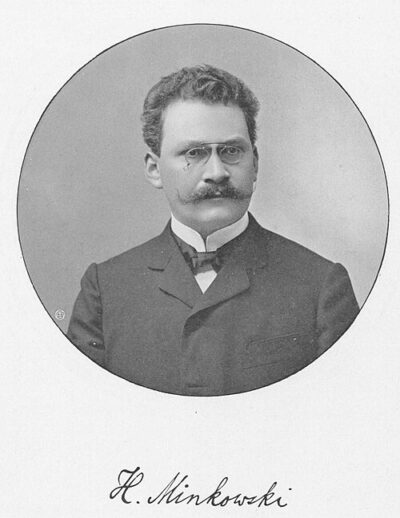
- Hermann Minkowski
- Wikipedias with a page
- 27
Wikidata item Q177596 (wikidata.org/wiki/Q177596), public domain (CC0). Copied 2026-11-17.
What Wikipedia says · copied November 17, 2026 · revision 1380963861
A spacetime diagram is a graphical illustration of locations in space at various times, especially in the special theory of relativity. Spacetime diagrams can show the geometry underlying phenomena such as time dilation and length contraction without the need of mathematical equations.
The history of an object's location through time traces out a line or curve on a spacetime diagram, referred to as the object's world line. Each point in a spacetime diagram represents a unique position in space and time and is referred to as an event.
The most well-known class of spacetime diagrams are known as Minkowski diagrams, developed by Hermann Minkowski in 1908. Minkowski diagrams are two-dimensional graphs that depict events as happening in a universe consisting of one space dimension and one time dimension. Unlike a regular distance-time graph, the distance is displayed on the horizontal axis and time on the vertical axis. Additionally, the time and space units of measurement are chosen in such a way that an object moving at the speed of light is depicted as following a 45° angle to the diagram's axes.
From the Wikipedia article “Spacetime diagram” (en.wikipedia.org/wiki/Spacetime_diagram), by its contributors, under CC BY-SA 4.0 (creativecommons.org/licenses/by-sa/4.0/). Copied 2026-11-17; not changed.
Confirmed Two sources agree. Cited One source, and it names where it got it. One source One source, without a reference of its own. Sources disagree The sources disagree. We show the best-supported value and keep theirs below.