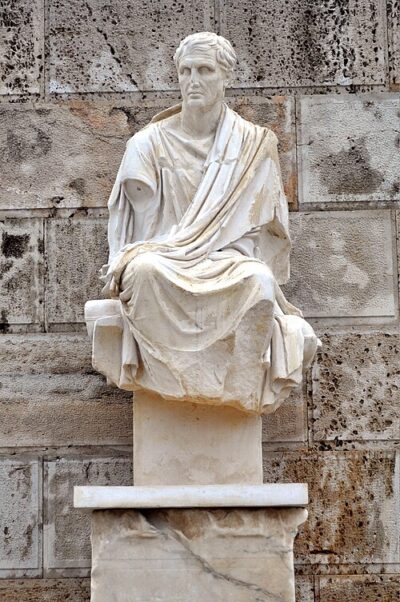
Misoumenos
Misoumenos is an ancient Greek comedy by Menander.
- Written by
- Menander
- Genre
- New Comedy
All 4 facts, and where they come from
Facts
4 facts · 0 confirmed by two sources · 0 cited · 4 from one source
Where this comes from
Papalocal keeps its own record. It started from these sources; what each one said is kept here as it was copied, so a change on their side never changes this page by itself. Tap one to read its version.
What Wikidata says · copied November 17, 2026 · revision 2479728878
- Described as
- ancient Greek comedy by Menander
- Other names
- Thrasonides, The Hated Man, Hated Man
- What it is
- dramatic work
- Written by
- Menander
- Genre
- New Comedy
- Language
- Ancient Greek
- Wikipedias with a page
- 5
Wikidata item Q6019567 (wikidata.org/wiki/Q6019567), public domain (CC0). Copied 2026-11-17.
What Wikipedia says · copied November 17, 2026 · revision 1371258113
Misoumenos (Greek: Μισούμενος), translated as The Hated Man, is an Ancient Greek comedy by Menander (342/41 – 292/91 BC). Once considered lost, fragments of more than 400 verses of the play have been found. However, most of these are seriously damaged, making it difficult to reconstruct the plot of the play. Separate lines from the prologue also survived by being quoted by later writers.
The surviving sources do not provide information regarding the time when the play was written and staged. At the same time, one of the fragments mentions royal power in Cyprus, which was abolished in 310/309 BC, so the action of the play takes place no later than this moment. Modern scholars date the play to approximately 300 BC.
Misoumenos seems to have been very popular in late antiquity, judging from the numerous papyrus fragments that have been recovered. A scene from act 5 of the play is depicted in a mosaic in the House of Menander.
From the Wikipedia article “Misoumenos” (en.wikipedia.org/wiki/Misoumenos), by its contributors, under CC BY-SA 4.0 (creativecommons.org/licenses/by-sa/4.0/). Copied 2026-11-17; not changed.
Confirmed Two sources agree. Cited One source, and it names where it got it. One source One source, without a reference of its own. Sources disagree The sources disagree. We show the best-supported value and keep theirs below.