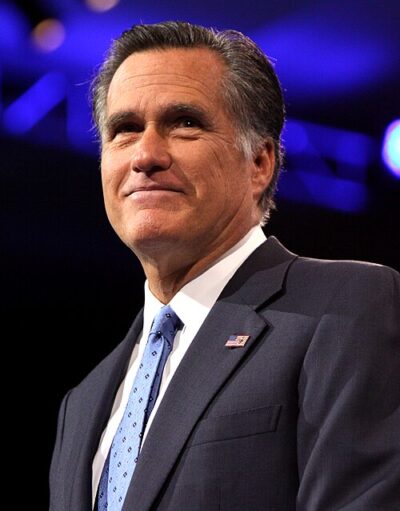
Mitt Romney's March 3 speech
Mitt Romney's March 3 speech is a political speech. It came out in 2016.
- Released
- March 3, 2016
- Written by
- Mitt Romney
All 4 facts, and where they come from
Facts
4 facts · 0 confirmed by two sources · 0 cited · 4 from one source
Where this comes from
Papalocal keeps its own record. It started from these sources; what each one said is kept here as it was copied, so a change on their side never changes this page by itself. Tap one to read its version.
What Wikidata says · copied November 16, 2026 · revision 2552837056
- Described as
- political speech
- What it is
- oration
- Written by
- Mitt Romney
- Released
- March 3, 2016
- Country
- United States
- Wikipedias with a page
- 5
Wikidata item Q23013731 (wikidata.org/wiki/Q23013731), public domain (CC0). Copied 2026-11-16.
What Wikipedia says · copied November 16, 2026 · revision 1360507649
On March 3, 2016, U.S. Republican politician Mitt Romney delivered a major speech for the Hinckley Institute of Politics at the Libby Gardner Hall in the University of Utah. In that speech, he denounced Donald Trump, who was then the front-runner in the 2016 Republican Party presidential primaries. He urged citizens to use tactical voting in the remaining primaries and caucuses to maximize the chance of denying Trump a delegate majority.
Romney's speech represented an almost unprecedented attack by a major U.S. party's most recent presidential nominee against the party's current front-runner for the nomination. Trump dismissed the comments, criticizing Romney for his losses in the 2008 and 2012 presidential elections and for "working with the establishment." Two months after the speech, Trump secured the Republican Party's presidential nomination and subsequently won the general election to become the president of the United States.
From the Wikipedia article “Mitt Romney's 2016 anti-Trump speech” (en.wikipedia.org/wiki/Mitt_Romney's_2016_anti-Trump_speech), by its contributors, under CC BY-SA 4.0 (creativecommons.org/licenses/by-sa/4.0/). Copied 2026-11-16; not changed.
Confirmed Two sources agree. Cited One source, and it names where it got it. One source One source, without a reference of its own. Sources disagree The sources disagree. We show the best-supported value and keep theirs below.