Mollweide projection
Mollweide projection is a map projection.
All 5 facts, and where they come from
Facts
5 facts · 0 confirmed by two sources · 0 cited · 5 from one source
Where this comes from
Papalocal keeps its own record. It started from these sources; what each one said is kept here as it was copied, so a change on their side never changes this page by itself. Tap one to read its version.
What Wikidata says · copied November 18, 2026 · revision 2550213374
- Described as
- map projection
- Other names
- Babinet projection, homalographic projection, homolographic projection, elliptical projection
- What it is
- equal-area projection; pseudocylindrical projection; map projection
- Named after
- Karl Mollweide; Jacques Babinet
- Wikipedias with a page
- 22
Wikidata item Q1141440 (wikidata.org/wiki/Q1141440), public domain (CC0). Copied 2026-11-18.
What Wikipedia says · copied November 18, 2026 · revision 1373410876
The Mollweide projection is an equal-area, pseudocylindrical map projection generally used for maps of the world or celestial sphere. It is also known as the Babinet projection, homalographic projection, homolographic projection, and elliptical projection. The projection trades accuracy of angle and shape for accuracy of proportions in area, and as such is used where that property is needed, such as maps depicting global distributions.
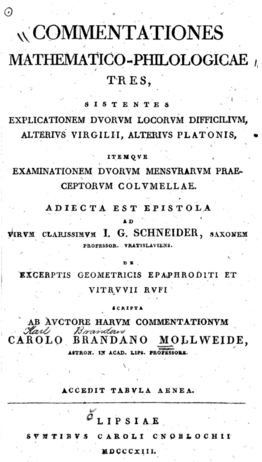
The projection was first published by mathematician and astronomer Karl (or Carl) Brandan Mollweide (1774–1825) of Leipzig in 1805. It was reinvented and popularized in 1857 by Jacques Babinet, who called it the homalographic projection. The variation homolographic arose from frequent nineteenth-century usage in star atlases.
From the Wikipedia article “Mollweide projection” (en.wikipedia.org/wiki/Mollweide_projection), by its contributors, under CC BY-SA 4.0 (creativecommons.org/licenses/by-sa/4.0/). Copied 2026-11-18; not changed.
Confirmed Two sources agree. Cited One source, and it names where it got it. One source One source, without a reference of its own. Sources disagree The sources disagree. We show the best-supported value and keep theirs below.
Picture: Wikimedia Commons: World borders mollweide.png · See Commons file page