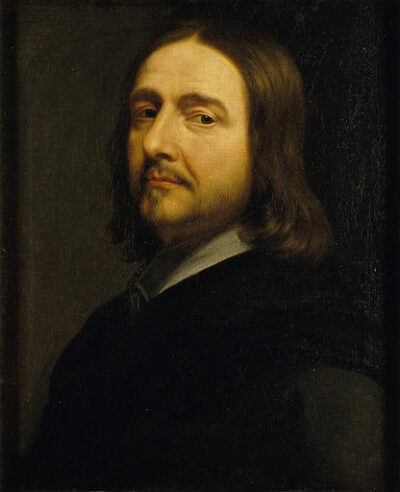
Mother Catherine-Agnès Arnault and Sister Catherine de Sainte Suzanne de Champaigne
Mother Catherine-Agnès Arnault and Sister Catherine de Sainte Suzanne de Champaigne is a painting by Philippe de Champaigne. It came out in 1662.
- Came out
- 1662
- Created by
- Philippe de Champaigne
- Genre
- portrait
All 5 facts, and where they come from
Facts
5 facts · 0 confirmed by two sources · 2 cited · 3 from one source
Where this comes from
Papalocal keeps its own record. It started from these sources; what each one said is kept here as it was copied, so a change on their side never changes this page by itself. Tap one to read its version.
What Wikidata says · copied November 17, 2026 · revision 2485303862
- Described as
- painting by Philippe de Champaigne
- Other names
- Mother Catherine-Agnes Arnault and Sister Catherine de Sainte Suzanne de Champaigne
- What it is
- painting · 1 reference
- Created by
- Philippe de Champaigne · 1 reference
- Genre
- portrait
- Came out
- 1662
- Owned by
- French State · 1 reference
- Wikipedias with a page
- 6
Wikidata item Q5419125 (wikidata.org/wiki/Q5419125), public domain (CC0). Copied 2026-11-17.
What Wikipedia says · copied November 17, 2026 · revision 1361270831
Ex-Voto de 1662 is a painting by the French artist Philippe de Champaigne now in the Louvre in Paris. One of Champaigne's most accomplished works, it is a votive offering (an ex-voto) by the painter which depicts a miracle involving his daughter that is said to have occurred at the Port-Royal-des-Champs Cistercian convent.
A ray of light illuminates Mother-Superior Agnès Arnauld, who experienced on the ninth day of her novena for Champaigne's daughter, Sister Catherine de Sainte Suzanne, the hope that a cure would come for Sister Catherine. Catherine (seated, praying) was the painter's only surviving child, and had been suffering from a paralyzing illness. Until that point, prayer and medical treatments ("potions, baths, unctions, and thirty bleedings") had proven futile. After the Mother-Superior's novena, Sister Catherine soon attempted to walk, and found herself increasingly mobile; the illness no longer seemed present. The painting is a statement of gratitude by the father for the cure of his daughter. The miracle it portrays also symbolized hope for the cause of the Jansenists, who were subject to persecution by ecclesiastical and civil authorities. The Jansenists followed Cornelius Jansen, who reasserted the theology of St. Augustine, and were in conflict with the Jesuits. Their refusal to sign a document condemning five propositions found in Jansen's Augustinus resulted in their being deprived of the sacraments and confined to the abbey, which was eventually torn down.The composition is unique among Champaigne's work, with the two figures having richly defined, "sculptural" forms, lending them vitality and setting them off from the restricted hues and "angular simplicity" of the setting (Rand 1990). The figures dominate the canvas, giving the painting a monumental quality. The texture, weight, and folds of the robes are modeled in great detail, revealing Champaigne's Flemish training. His decision to portray the moment that Mother-Superior Agnès is instilled with hope, rather than the cure itself, is evident in the fact that the ray of light illuminates her instead of his daughter. The light develops a "chronological tension" that suggests "what will happen as a result of what is happening".
The painting includes a Latin inscription on the wall on the left of the painting. Neither the text nor the lettering were Champaigne's work.The inscription, addressed to Christ, recounts that Sister Catherine suffered for 14 months from a high fever and that half her body was paralyzed; that she prayed with Mother Agnès and her health was restored, and again she offered herself to Christ; and that Champaigne offers the painting as a testament to this miracle and to express his joy.
From the Wikipedia article “Ex-Voto de 1662” (en.wikipedia.org/wiki/Ex-Voto_de_1662), by its contributors, under CC BY-SA 4.0 (creativecommons.org/licenses/by-sa/4.0/). Copied 2026-11-17; not changed.
Confirmed Two sources agree. Cited One source, and it names where it got it. One source One source, without a reference of its own. Sources disagree The sources disagree. We show the best-supported value and keep theirs below.
Picture: Wikimedia Commons: La Mère Catherine-Agnès Arnault et la sœur Catherine de Sainte Suzanne de Champaigne - Philippe de Champaigne - Musée du Louvre Peintures INV 1138.jpg · See Commons file page