Mott–Bethe formula
Mott–Bethe formula is a Mathematical formula.
All 2 facts, and where they come from
Facts
2 facts · 0 confirmed by two sources · 0 cited · 2 from one source
Where this comes from
Papalocal keeps its own record. It started from these sources; what each one said is kept here as it was copied, so a change on their side never changes this page by itself. Tap one to read its version.
What Wikidata says · copied November 16, 2026 · revision 1524934662
- Described as
- Mathematical formula
- What it is
- formula; scientific theory
- Wikipedias with a page
- 1
Wikidata item Q6918710 (wikidata.org/wiki/Q6918710), public domain (CC0). Copied 2026-11-16.
What Wikipedia says · copied November 16, 2026 · revision 1311490862
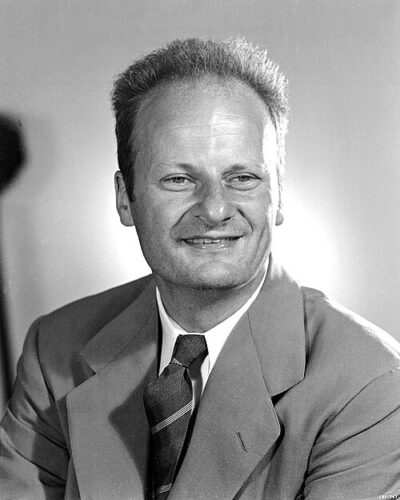
The Mott–Bethe formula is an approximation used to calculate atomic electron scattering form factors, fe(q,Z), from atomic X-ray scattering form factors, fx(q,Z). The formula was derived independently by Hans Bethe and Neville Mott both in 1930, and simply follows from applying the first Born approximation for the scattering of electrons via the Coulomb interaction together with the Poisson equation for the charge density of an atom (including both the nucleus and electron cloud) in the Fourier domain. Following the first Born approximation,
fe(q,Z)=me232π3ℏ2ϵ0(Z−fx(q,Z)q2)=18π2a0(Z−fx(q,Z)q2)≈(0.2393 nm−1)⋅(Z−fx(q,Z)q2)
Here, q is the magnitude of the scattering vector of momentum-transfer cross section in reciprocal space (in units of inverse distance), Z the atomic number of the atom, ℏ is the Planck constant, ϵ0 is the vacuum permittivity, and m0 is the electron rest mass, a0 is the Bohr Radius, and fx(q,Z) is the dimensionless X-ray scattering form factor for the electron density.
The electron scattering factor fe(q,Z) has units of length, as is typical for the scattering factor, unlike the X-ray form factor fx(q,Z), which is usually presented in dimensionless units. To perform a one-to-one comparison between the electron and X-ray form factors in the same units, the X-ray form factor should be multiplied by the square root of the Thomson cross section σT=re, where re is the classical electron radius, to convert it back to a unit of length.
The Mott–Bethe formula was originally derived for free atoms, and is rigorously true provided the X-ray scattering form factor is known exactly. However, in solids, the accuracy of the Mott–Bethe formula is best for large values of q (q>0.5 Å−1) because the distribution of the charge density at smaller q (i.e. long distances) can deviate from the atomic distribution of electrons due the chemical bonds between atoms in a solid. For smaller values of q, fe(q,Z) can be determined from tabulated values, such as those in the International Tables for Crystallography using (non)relativistic Hartree–Fock calculations, or other numerical parameterizations of the calculated charge distribution of atoms.
From the Wikipedia article “Mott–Bethe formula” (en.wikipedia.org/wiki/Mott–Bethe_formula), by its contributors, under CC BY-SA 4.0 (creativecommons.org/licenses/by-sa/4.0/). Copied 2026-11-16; not changed.
Confirmed Two sources agree. Cited One source, and it names where it got it. One source One source, without a reference of its own. Sources disagree The sources disagree. We show the best-supported value and keep theirs below.