Museum Godeffroy
Museum Godeffroy is a museum in Hamburg, Germany. It was founded in 1861 by Johann Cesar VI. Godeffroy.
- Founded
- 1861
- Founded by
- Johann Cesar VI. Godeffroy
- Country
- Germany
All 6 facts, and where they come from
Facts
6 facts · 0 confirmed by two sources · 1 cited · 5 from one source
Where this comes from
Papalocal keeps its own record. It started from these sources; what each one said is kept here as it was copied, so a change on their side never changes this page by itself. Tap one to read its version.
What Wikidata says · copied November 18, 2026 · revision 2568295371
- Described as
- museum in Hamburg, Germany
- What it is
- museum
- Founded
- 1861
- Ended
- 1885
- Founded by
- Johann Cesar VI. Godeffroy · 1 reference
- Located in
- Hamburg
- Country
- Germany
- Wikipedias with a page
- 5
Wikidata item Q832762 (wikidata.org/wiki/Q832762), public domain (CC0). Copied 2026-11-18.
What Wikipedia says · copied November 18, 2026 · revision 1377870566
The Museum Godeffroy was a museum in Hamburg, Germany, which existed from 1861 to 1885.
The collection was founded by Johann Cesar VI. Godeffroy, who became a wealthy shipping magnate a few years after the expansion of the trade towards Australia and the South Seas. His expert collectors and captains brought back to Hamburg zoological, botanical and ethnographic material. Captains of vessels, traders and missionaries received exact instructions and appropriate equipment so that they could collect soft bodied animals into alcohol, properly set butterflies or beetles, and prepare bird and mammal skins and skulls. Herbarium instructions and mineral collecting kits were also issued. Duplicate or unwanted parts were sold.
Throughout the museum's history it also sold human skulls from the Pacific regions (including Australia) where the company had a monopoly. This was very profitable. Anthropometry and "Missing Link" theories required especially Aborigine skulls and these were sold to scientific institutions and museums worldwide. The more important material was sold to Otto Finsch and Rudolf Virchow, then pre-eminent German physical anthropologists.
The museum opened in 1861 in parts of the Kontorhäuser (Counting House Building) of the company "J. C. Godeffroy & son". The exhibition on two floors covered the natural history, ethnography and anthropology of the South Seas. Mammals, birds, reptiles, fish, amphibians, butterflies, beetles and other insects, marine life (especially shells), masks, totems, costume, weapons, personal ornament and anthropological subjects, aboriginal skulls, photographs of native peoples and so on were displayed in small cases. Larger items, such as boats and reconstructed houses, stood free. Admission was weekdays from 11 to 14 o'clock for one Mark, and on the weekends from 10 to 14 o'clock for 50 Pfennig.
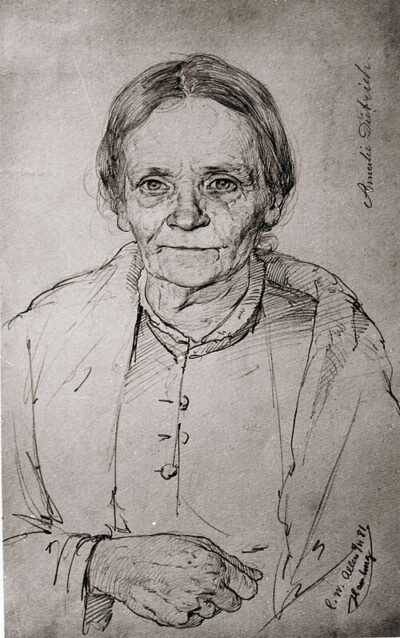
Experts in various fields ("Auftragssammler") were employed on expeditions and for scientific examination and other work on the collection. They included Eduard Heinrich Graeffe, Amalie Dietrich, Johann Stanislaus Kubary, Richard Parkinson, Andrew Garrett, Eduard Dämel, Franz Hübner, Alfred Tetens and Theodor Kleinschmidt, among others.
The overall curator was Johann Schmeltz (1839–1909). In addition, he provided 1865 and 1881 sales catalogs and edited the Journal des Museum Godeffroy. A number of binomial names were published for the first time in these publications giving them significance in classification. The Semper brothers, also from Hamburg, Otto (1830–1907), Karl (1832–1893) and Georg (1837–1909) played an important part in the assembly and conservation of the museum's holdings. Georg named the rare Samoa butterfly Papilio godeffroyi for Johann Godeffroy.
After the discontinuation of all payments in Dec. 1879 the museum existed further as it did not belong to the company J.C. Godeffroy & Son anymore. Dr. Wilhelm Godeffroy became the owner for a grant to the company. Since 1881 the museum had been threatened in its existence, as all buildings should be pulled down in the area. The abridgement began 1885. The same year in which Cesar Godeffroy died, Dr. Wilhelm Godeffroy finished the negotiations without reaching his wish, to keep the collection in its own rooms in Hamburg.
A large number of exhibits and specimens survive today in the Museum für Völkerkunde zu Leipzig (now merged with the Staatlichen Ethnographischen Sammlung Sachsens and containing 5000 objects comprehensive for Micronesia and Fiji and including objects from Melanesia and Polynesia); the Museum für Völkerkunde Hamburg; the Ethnological Museum of Berlin; the Pitt Rivers Museum in Oxford; and the D'Arcy Thompson Zoology Museum in Dundee. There is also zoological material in the Biozentrum Grindel und Zoologisches Museum, the Museum für Naturkunde, Berlin, the Museo Civico di Storia Naturale di Trieste and the Naturhistorisches Museum in Vienna.The Godeffroy Collection of Australian and South Pacific insects is in the Victoria Museum in Melbourne, Australia.The zoological material supports Faunistic of Oceania and Australasia
Johann Schmeltz, the former curator was already a co-worker of the Ethnographic Museum in Leiden (now the Rijksmuseum voor Volkenkunde), which had purchased parts of the ethnographic collection.
From the Wikipedia article “Museum Godeffroy” (en.wikipedia.org/wiki/Museum_Godeffroy), by its contributors, under CC BY-SA 4.0 (creativecommons.org/licenses/by-sa/4.0/). Copied 2026-11-18; not changed.
Confirmed Two sources agree. Cited One source, and it names where it got it. One source One source, without a reference of its own. Sources disagree The sources disagree. We show the best-supported value and keep theirs below.
Picture: Wikimedia Commons: Der alte Wandrahm 1883.jpg · See Commons file page