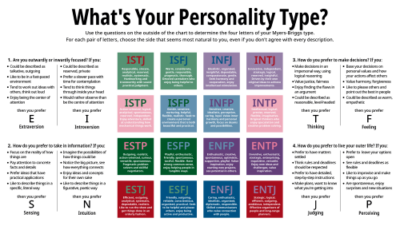
Myers-Briggs Type Indicator
Myers-Briggs Type Indicator is a model of personality types. It came out in 1944.
- Came out
- 1944
All 6 facts, and where they come from
Facts
6 facts · 0 confirmed by two sources · 0 cited · 6 from one source
Where this comes from
Papalocal keeps its own record. It started from these sources; what each one said is kept here as it was copied, so a change on their side never changes this page by itself. Tap one to read its version.
What Wikidata says · copied November 17, 2026 · revision 2547948907
- Described as
- model of personality types
- Other names
- MBTI®, MBTI
- What it is
- psychological test; pseudoscience
- Came out
- 1944
- Named after
- Katherine Cook Briggs; Isabel Briggs Myers
- Official website
- https://www.myersbriggs.org
- Wikipedias with a page
- 48
Wikidata item Q897939 (wikidata.org/wiki/Q897939), public domain (CC0). Copied 2026-11-17.
What Wikipedia says · copied November 17, 2026 · revision 1385620168
The Myers–Briggs Type Indicator (MBTI) is a self-report questionnaire that makes pseudoscientific claims to categorize individuals into 16 distinct psychological types (often called personality types). The test assigns a binary letter value to each of four dichotomous categories: introversion or extraversion, sensing or intuition, thinking or feeling, and judging or perceiving. This produces a four-letter test result, such as "INTJ" or "ESFP", representing one of the 16 types.
The original version of the MBTI was constructed during World War II by Americans Katharine Cook Briggs and her daughter Isabel Briggs Myers, inspired by Swiss psychiatrist Carl Jung's 1921 book Psychological Types. Isabel Myers was particularly fascinated by the concept of "introversion", and she typed herself as an INFP. However, she thought that the book was too complex for the general public and tried to organize the Jungian cognitive functions to make it more accessible.
As a psychometric indicator, the test exhibits significant deficiencies, including poor validity, poor reliability, measuring supposedly dichotomous categories that are not independent, and not being comprehensive. Most of the research supporting the MBTI's validity has been produced by the Center for Applications of Psychological Type, an organization run by the Myers–Briggs Foundation, and published in the center's own journal, the Journal of Psychological Type (JPT), raising questions of independence, bias and conflict of interest. Nevertheless, due to the Barnum effect, participants often attribute a level of accuracy to the results that is disproportionate to their scientific credibility.
The MBTI is not considered useful in psychological practice or study, since it lacks predictive power. According to University of Pennsylvania professor Adam Grant, "There is no evidence behind it. The traits measured by the test have almost no predictive power when it comes to how happy you'll be in a given situation, how well you'll perform at your job, or how satisfied you'll be in your marriage." Despite controversies over validity, the instrument has demonstrated widespread influence since its adoption by the Educational Testing Service in 1962. It is estimated that 50 million people have taken the MBTI and that 10,000 businesses, 2,500 colleges and universities, and 200 government agencies in the United States use it.
From the Wikipedia article “Myers–Briggs Type Indicator” (en.wikipedia.org/wiki/Myers–Briggs_Type_Indicator), by its contributors, under CC BY-SA 4.0 (creativecommons.org/licenses/by-sa/4.0/). Copied 2026-11-17; not changed.
Confirmed Two sources agree. Cited One source, and it names where it got it. One source One source, without a reference of its own. Sources disagree The sources disagree. We show the best-supported value and keep theirs below.
Picture: User:JakeBeech, via Wikimedia Commons · CC BY-SA 3.0