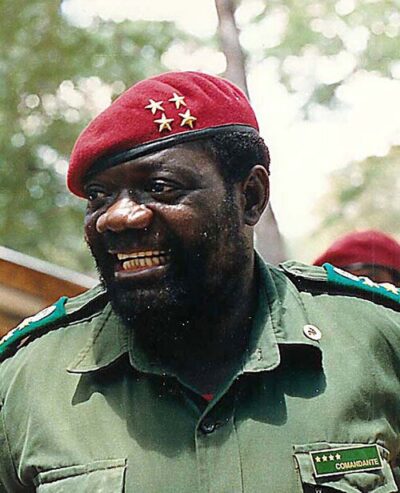
National Union for the Total Independence of Angola
National Union for the Total Independence of Angola is a political party in Angola. It was founded in 1966 by Jonas Malheiro Savimbi. Its headquarters are in Luanda. It stands for conservatism, nationalism and social liberalism.
- Country
- Angola
- Founded
- March 13, 1966
- Ideology
- conservatism
- Chair
- Adalberto Costa Júnior (2019–)
All 12 facts, and where they come from
Facts
12 facts · 0 confirmed by two sources · 2 cited · 10 from one source
Where this comes from
Papalocal keeps its own record. It started from these sources; what each one said is kept here as it was copied, so a change on their side never changes this page by itself. Tap one to read its version.
What Wikidata says · copied November 17, 2026 · revision 2527952014
- Described as
- political party in Angola
- Other names
- UNITA
- What it is
- political party
- Founded
- March 13, 1966 · 1 reference
- Founded by
- Jonas Malheiro Savimbi · 2 references
- Headquarters
- Luanda
- Country
- Angola
- Chair
- Isaías Samakuva (2003–2019) · 1 reference; Jonas Malheiro Savimbi (1966–2002) · 1 reference
- Ideology
- conservatism; nationalism; social liberalism · 1 reference; Christian democracy · 1 reference
- Official website
- https://unita-angola.co.ao/
- Wikipedias with a page
- 53
Wikidata item Q28699 (wikidata.org/wiki/Q28699), public domain (CC0). Copied 2026-11-17.
What Wikipedia says · copied November 17, 2026 · revision 1383137270
The National Union for the Total Independence of Angola (Portuguese: União Nacional para a Independência Total de Angola, abbr. UNITA) is the second-largest political party in Angola. Founded in 1966, UNITA fought alongside the People's Movement for the Liberation of Angola (MPLA) and the National Liberation Front of Angola (FNLA) in the Angolan War for Independence (1961–1975) and then against the MPLA in the ensuing civil war (1975–2002). The war was one of the most prominent Cold War proxy wars, with UNITA receiving military aid initially from the People's Republic of China until 1975 and later from the United States and apartheid South Africa while the MPLA received material and technical support from the Soviet Union and its allies, especially Cuba.
Until 1996, UNITA was funded through Angolan diamond mines in both Lunda Norte and Lunda Sul along the Cuango River valley, especially the Catoca mine, which was Angola's only Kimberlite mine at that time. Valdemar Chindondo served as chief of staff in the government of UNITA, pro-Western rebels, during the Angolan Civil War (1975–2002). Jonas Savimbi, leader of UNITA, allegedly ordered Chindondo's assassination.
Savimbi's successor as president of UNITA was Isaías Samakuva. Following Savimbi's death, UNITA abandoned armed struggle and participated in electoral politics. The party won 51 out of 220 seats in the 2017 parliamentary election. Samakuva resigned as party leader in November 2019, being replaced by Adalberto Costa Júnior.
From the Wikipedia article “UNITA” (en.wikipedia.org/wiki/UNITA), by its contributors, under CC BY-SA 4.0 (creativecommons.org/licenses/by-sa/4.0/). Copied 2026-11-17; not changed.
Confirmed Two sources agree. Cited One source, and it names where it got it. One source One source, without a reference of its own. Sources disagree The sources disagree. We show the best-supported value and keep theirs below.