Nawab
Nawab is a Mughal title. It is an office of Mughal dynasty.
- Office of
- Mughal dynasty
- Country
- Mughal Empire
All 4 facts, and where they come from
Facts
4 facts · 0 confirmed by two sources · 0 cited · 4 from one source
Where this comes from
Papalocal keeps its own record. It started from these sources; what each one said is kept here as it was copied, so a change on their side never changes this page by itself. Tap one to read its version.
What Wikidata says · copied November 18, 2026 · revision 2570108698
- Described as
- Mughal title
- Other names
- Nawwab, Nabob, Naybob, Na'ib, Naib, Nawaab
- What it is
- title; position
- Country
- Mughal Empire · 1 reference
- Office of
- Mughal dynasty
- Wikipedias with a page
- 37
Wikidata item Q23017648 (wikidata.org/wiki/Q23017648), public domain (CC0). Copied 2026-11-18.
What Wikipedia says · copied November 18, 2026 · revision 1380735338
Nawab is a royal title indicating a ruler, often of a South Asian state, in many ways comparable to the Western title of Prince. The relationship of a Nawab to the Emperor of India has been compared to that of the Kings of Saxony to the German Emperor. In earlier times the title was ratified and bestowed by the reigning Mughal emperor to semi-autonomous Muslim rulers of subdivisions or princely states in the Indian subcontinent loyal to the Mughal Empire, for example the Nawabs of Bengal. Various Nawabs were permitted to maintain this title under the suzerainty of the Maratha Empire.
"Nawab" usually refers to males and literally means Viceroy; the female equivalent is "Begum" or "Nawab Begum". The primary duty of a Nawab was to uphold the sovereignty of the Mughal emperor along with the administration of a certain province.
The title of "nawabi" was also awarded as a personal distinction by the paramount power, similar to a British peerage, to persons and families who ruled a princely state for various services to the Government of India. In some cases, the titles were also accompanied by jagir grants, either in cash revenues and allowances or land-holdings. During the British Raj, some of the chiefs, or sardars, of large or important tribes were also given the title, in addition to traditional titles already held by virtue of chieftainship.
The term "Zamindari" was originally used for the subahdar (provincial governor) or viceroy of a subah (province) or regions of the Mughal Empire.
From the Wikipedia article “Nawab” (en.wikipedia.org/wiki/Nawab), by its contributors, under CC BY-SA 4.0 (creativecommons.org/licenses/by-sa/4.0/). Copied 2026-11-18; not changed.
Confirmed Two sources agree. Cited One source, and it names where it got it. One source One source, without a reference of its own. Sources disagree The sources disagree. We show the best-supported value and keep theirs below.
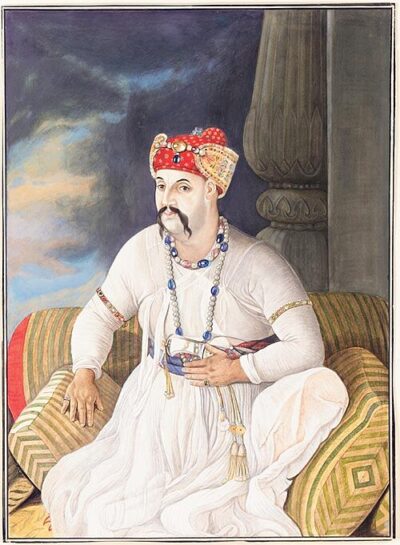
Picture: Wikimedia Commons: A Nawab of Mughal dynasty, India, 17th-18th century.jpg · See Commons file page